Restaurant Technology · Uncategorized
Triple Bottom Line Restaurants: How to Cut Costs 30% While Going Green (No Upfront Investment Required)
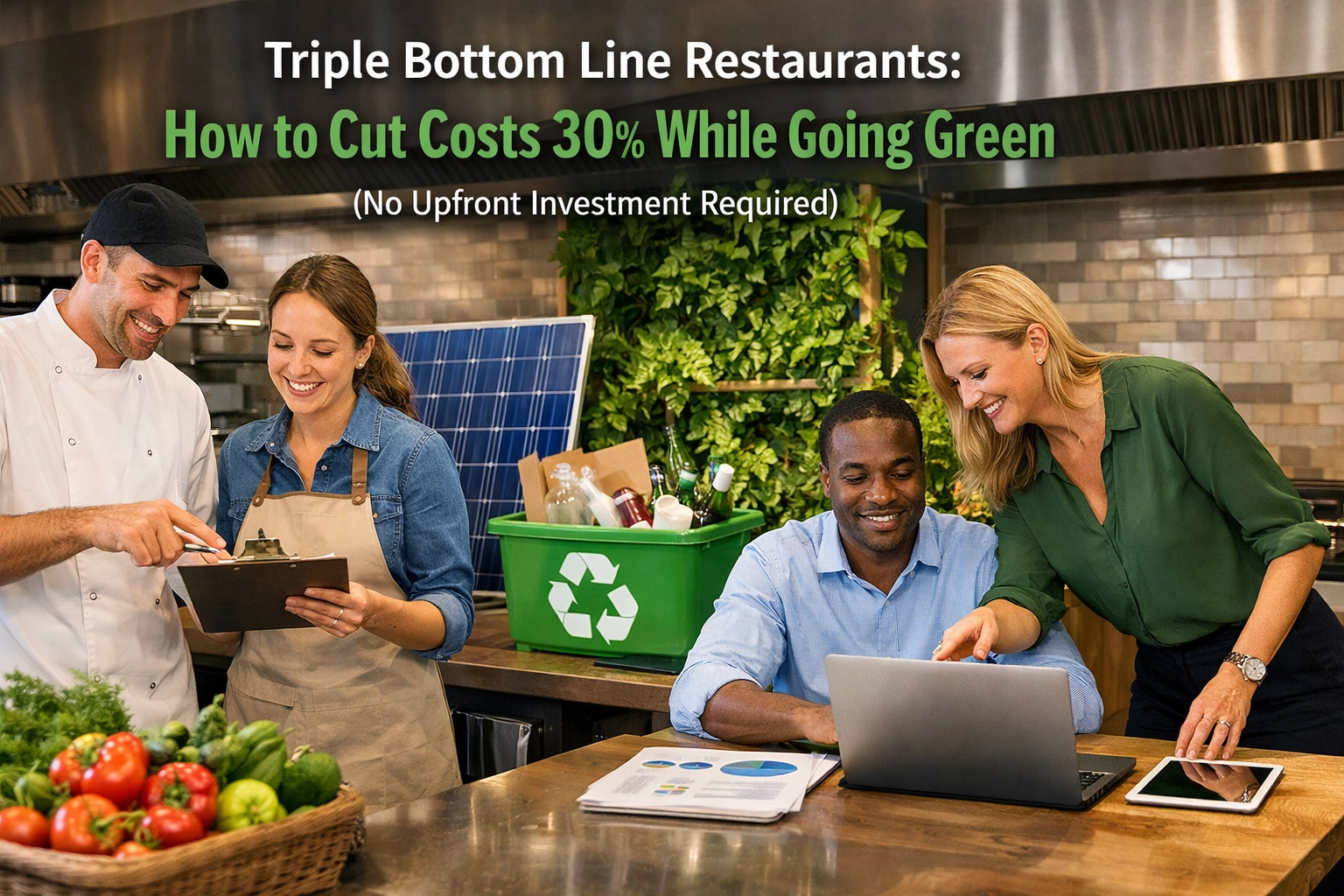
Let's get one thing straight: "going green" doesn't mean hemorrhaging cash on solar panels and composting equipment while your margins tank. That's the old playbook. The new reality? Triple bottom line (TBL) restaurants are outperforming traditional operations by 4.4% in annual ROI (13.5% vs 9.1%), and they're doing it by treating sustainability like the profit center it actually is.
Here's the kicker, most of the biggest cost savings in TBL don't require writing a single check upfront. They require rethinking how you operate, not renovating your entire kitchen. And in 2026, with restaurant prices rising at 6% (double the grocery store rate of 3%), you can't afford to ignore operational efficiency anymore.
What the Hell is Triple Bottom Line, Anyway?
TBL is pretty simple: instead of just chasing profit, you optimize for three things simultaneously, People, Planet, and Profit. It's not hippie nonsense; it's smart business. When you take care of your staff (People), reduce waste and energy consumption (Planet), you naturally improve your bottom line (Profit). They're not competing priorities, they're connected levers.
Think of it this way: paying your dishwasher $2 more per hour (People) reduces turnover by 30%, which saves you $5,000 per replacement hire. Meanwhile, training that same dishwasher to scrape plates properly (Planet) cuts your food waste by 15%, saving another $8,000 annually. That's a 40x return on a $2/hour raise. That's triple bottom line.

The 30% Cost Reduction Breakdown: Where the Money Actually Hides
Let's break down where you're leaking cash right now, and how going green plugs those holes without touching your line of credit.
1. Energy Efficiency: The 8-12% Savings You're Ignoring
Your HVAC, refrigeration, and kitchen equipment account for 60-70% of your total energy bill. But here's the thing: most energy efficiency upgrades don't cost a dime upfront if you know where to look.
The No-Cost Moves:
- Programmable thermostats: Your HVAC doesn't need to run full blast at 3 AM. Set back temperatures during closed hours and save 10-15% on heating/cooling immediately.
- LED retrofits through utility rebates: Most states offer free LED bulb replacements through utility company programs. LEDs use 75% less energy and last 25x longer than incandescent bulbs.
- Walk-in cooler strip curtains: A $50 fix that reduces cold air loss by 40%. ROI in 3 weeks.
- Energy audits: Most utility companies offer free energy audits. They'll literally tell you where you're burning money.
Real Numbers: A 5,000 sq ft casual dining restaurant in Ohio reduced energy costs from $4,200/month to $3,100/month by implementing these free/low-cost fixes. That's $13,200 in annual savings with zero capital expenditure.
2. Food Waste Reduction: The Silent 4-10% Margin Killer
Americans waste 30-40% of the food supply, and restaurants are responsible for a massive chunk of that. But every tomato you toss is pure profit walking into the dumpster.
The No-Cost Moves:
- Waste tracking for one week: Just measuring food waste for 7 days makes staff 20% more conscious about portioning and prep. Use a clipboard, not software.
- Nose-to-tail/root-to-stem cooking: Vegetable scraps become stocks. Chicken bones become soup. Stale bread becomes croutons. You already own this inventory, use all of it.
- FIFO enforcement: First-in, first-out isn't sexy, but it prevents spoilage. Train your team to rotate stock religiously.
- Smaller plates: Studies show reducing plate size by 1-2 inches cuts food waste by 20% without customers noticing or complaining.
Real Numbers: The average restaurant wastes 4-10% of food purchased. If you're doing $1.5M in revenue with a 30% COGS, you're throwing away $18,000-$45,000 annually. Cut that waste by half (totally doable with the tactics above), and you've just added $9,000-$22,500 to your bottom line.

3. Local Sourcing: The Counterintuitive Cost Saver
Wait, isn't local food more expensive? Sometimes. But when you factor in reduced spoilage (shorter supply chain), premium pricing power (customers pay 15% more for "local" menu items), and lower transportation volatility, local sourcing often comes out ahead.
The No-Cost Moves:
- Direct farmer relationships: Cut out the distributor middleman for your highest-volume produce items. Most small farms will deliver for free if you commit to weekly orders above $200.
- Seasonal menu design: Build your menu around what's abundant (cheap) locally each season, not what Sysco has on special.
- Menu premiums: Add "Locally-Sourced" or "Farm-to-Table" to menu items and increase prices by 10-15%. Customers expect to pay more for local, so capture that value.
Real Numbers: A farm-to-table restaurant in North Carolina switched 40% of produce to direct-from-farmer sourcing and saw ingredient costs drop 8% while menu prices increased 12%. That's a 20-point swing in gross margin.
4. Staff Retention: The $5,000-Per-Turnover Tax You're Paying
Here's the brutal truth: replacing an hourly employee costs $5,000-$7,000 when you factor in lost productivity, recruitment, training, and mistakes during the learning curve. The average restaurant has 75% annual turnover. Do that math on a 30-person team, and you're lighting $112,500 on fire every year.
The No-Cost (or Low-Cost) Moves:
- Transparent scheduling: Post schedules 2 weeks in advance. Sounds basic, but it reduces turnover by 18% according to recent workforce studies.
- Career pathing conversations: Spend 15 minutes per quarter with each employee discussing their career goals. It costs you nothing but shows you're invested in them as humans.
- Profit-sharing or tip pooling: Align incentives. When everyone wins together, they stay together.
- Better onboarding: A structured 2-week onboarding program (not "shadow someone and figure it out") reduces 90-day turnover by 30%.
Real Numbers: Reducing turnover from 75% to 50% on a 30-person team saves approximately $56,000 annually in replacement costs. And guess what? Staff who stick around provide better service, which drives higher check averages and repeat business. The compounding effect is massive.

The Real ROI: Why TBL Restaurants Are Crushing Traditional Models
Let's zoom out. When you stack these savings together, here's what a realistic 30% cost reduction looks like for a $1.5M revenue restaurant:
- Energy efficiency: $13,200/year
- Food waste reduction: $15,000/year
- Local sourcing margin improvement: $24,000/year
- Staff retention savings: $56,000/year
Total annual savings: $108,200
That's 7.2% of revenue dropping straight to your bottom line. And we haven't even touched water conservation, sustainable packaging, or dynamic pricing strategies.
But here's the real kicker: customers will pay 15% more for restaurants with strong sustainability practices. That means your $18 entree becomes $20.70, and your margins expand even further. TBL isn't just about cutting costs, it's about creating pricing power.
How to Start with Zero Upfront Investment (Yes, Really)
Most operators hear "sustainability" and think they need to drop $100K on a solar array and a rooftop herb garden. That's the wrong entry point. Here's the right one:
Week 1: Audit & Measure
- Track food waste for 7 days
- Request a free energy audit from your utility company
- Survey staff on turnover drivers (exit interviews or anonymous surveys)
Week 2-4: Implement Quick Wins
- LED bulbs through rebate programs
- FIFO enforcement training
- Programmable thermostat installation
- Reach out to 3 local farms about direct relationships
Month 2-3: Build Systems
- Create a waste reduction training program
- Implement transparent scheduling
- Design one seasonal menu cycle
- Start tracking retention metrics
Month 4+: Optimize & Scale
- Review data monthly
- Expand local sourcing based on what worked
- Reinvest savings into higher-impact initiatives
This roadmap requires zero capital expenditure. It requires operational discipline, staff buy-in, and a willingness to challenge "the way we've always done it."

The Restaurant Revenue Incubator Advantage
Here's where we come in. At Restaurant Revenue Incubator, we specialize in implementing these exact strategies with no upfront cost to you. We get paid when you see results, which means we're incentivized to find the biggest savings fastest.
Our cost reduction services include:
- Complete operational audits (energy, waste, labor, supply chain)
- Triple bottom line roadmap development
- Vendor renegotiation and local sourcing connections
- Staff retention program design
We've helped restaurants cut operational costs by an average of 22-35% in the first year: while improving both employee satisfaction and customer experience. That's the power of aligning People, Planet, and Profit.
The Bottom Line (All Three of Them)
Going green doesn't mean sacrificing profitability. In 2026, it's actually the fastest path to stronger margins. The restaurants winning right now aren't choosing between sustainability and profit: they're using sustainability to drive profit.
The 30% cost reduction isn't a myth. It's hiding in your energy bills, your dumpster, your supply chain, and your revolving door of staff turnover. You just need to know where to look: and have the operational discipline to actually fix it.
Want to see where your biggest opportunities are? Let's talk. We'll do a free diagnostic on your operation and show you exactly where that 30% is hiding. No upfront cost, no equity, no interest. Just results.
Because at the end of the day, the best kind of green is the kind that shows up on your P&L.