Restaurant Technology · Uncategorized
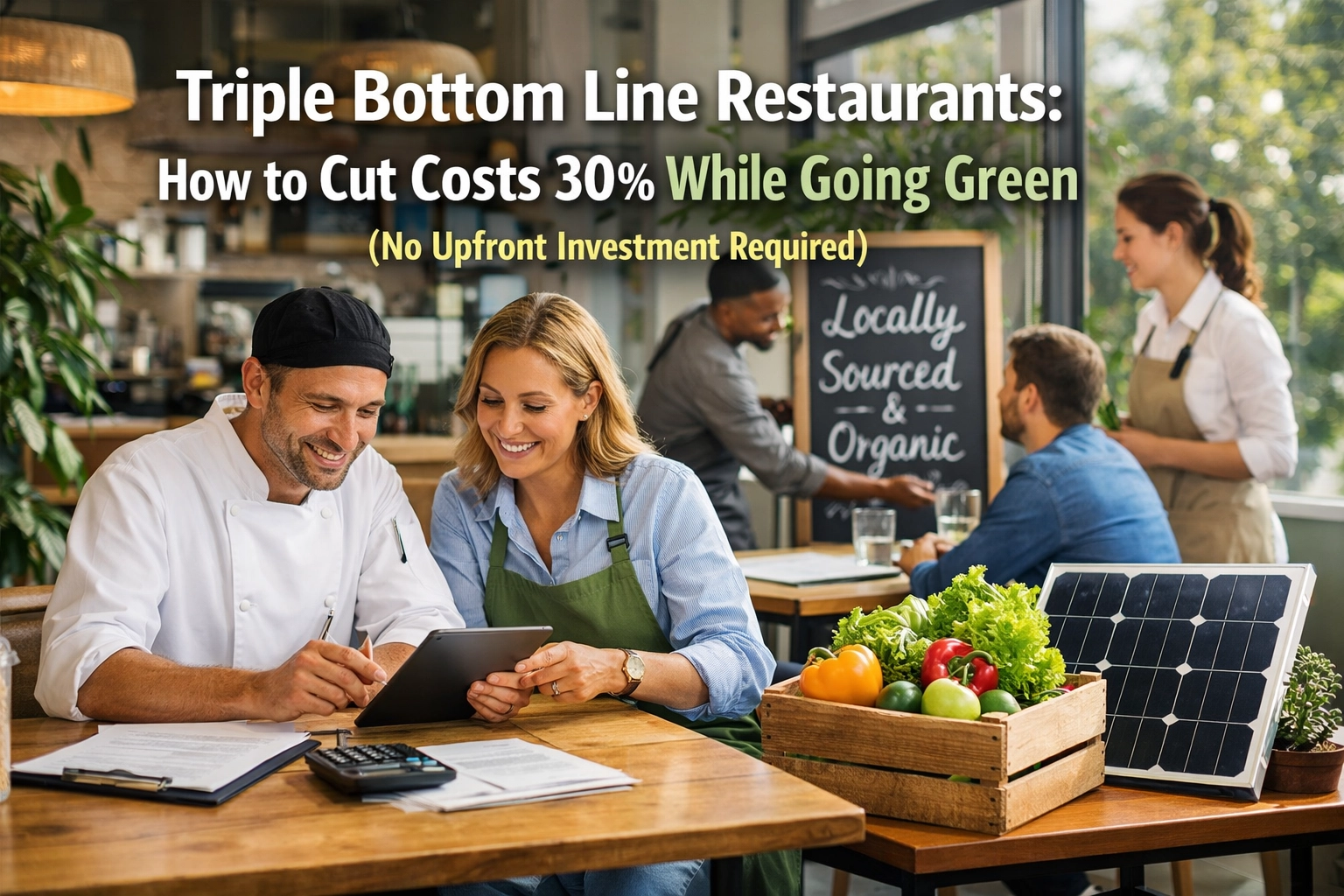
Triple Bottom Line Restaurants: How to Cut Costs 30% While Going Green (No Upfront Investment Required)
Let me guess: someone told you that "going green" means buying expensive composters, solar panels, and reusable straws made from unicorn hair. And that you'd need to take out a second mortgage just to get started.
Here's the truth: sustainability isn't a cost center, it's a profit center. And if you play it right, you can slash your operating costs by 30% or more without writing a single check upfront.
Welcome to the Triple Bottom Line framework for restaurants. It's not tree-hugging hippie nonsense. It's a business model that measures success across three equally important dimensions: People, Planet, and Profit. And right now, with only 42% of restaurant operators reporting profitability in 2025, this isn't just nice-to-have, it's survival.
What the Hell is Triple Bottom Line, Anyway?
The Triple Bottom Line (TBL) is an accounting framework that goes beyond the traditional P&L. Instead of just tracking dollars, you measure impact across three pillars:
People (Social Responsibility): How you treat employees, customers, and your community
Planet (Environmental Sustainability): Your ecological footprint and resource efficiency
Profit (Economic Viability): The financial health that keeps the lights on
Here's what most consultants won't tell you: these three pillars aren't competing priorities. They're symbiotic. When you reduce food waste (Planet), you lower COGS and improve margins (Profit) while feeding employees better family meals (People). It's a multiplier effect, not a trade-off.

The 30% Cost Reduction Playbook (Zero Upfront Investment)
Let's get tactical. Here are the highest-impact moves that require nothing but operational discipline and smart partnerships.
Planet: The Energy & Waste Audit That Pays You Back
The Move: Conduct a zero-cost energy audit with your utility provider. Most major utilities offer free commercial audits that identify inefficiencies. Then negotiate a power purchase agreement (PPA) for LED retrofits or HVAC upgrades where the vendor covers installation costs and gets paid back through your energy savings.
The Math: Restaurants waste approximately 4-10% of food purchased before it even reaches the guest. A typical $2M/year restaurant is throwing away $80,000-$200,000 annually. LED lighting alone can cut energy bills by 25-50% in the dining room and kitchen.
Real Talk: We worked with a fast-casual group in Austin that implemented a waste tracking system (literally just a clipboard and a scale) and cut food waste by 38% in 90 days. That translated to $47,000 in annual savings for a single location. No software purchase required: just operational discipline.
Profit: The Menu Engineering Secret Nobody Uses
The Move: Implement dynamic menu pricing based on commodity costs and real-time inventory. This doesn't mean raising prices: it means strategically featuring high-margin items when ingredient costs are favorable and steering traffic away from low-margin dishes when costs spike.
The Tech Play: Most POS systems already have this functionality: you're just not using it. We've seen operators slash menu complexity by 20% (reducing SKU counts) while increasing average check by 12% simply by promoting the right dishes at the right time.
The Sustainability Angle: Smaller menus = less waste = better margins. A Harvard Business School study found that restaurants with smaller, seasonal menus had 31% higher profitability than those with sprawling year-round options.

People: The Retention Strategy That Saves Six Figures
The Move: Invest in predictable scheduling and transparent promotion paths. This costs exactly $0 but requires management discipline.
The Math: The average cost to replace a line cook is $5,864. For a manager, it's $13,000. If you're running 30% annual turnover (industry average), a 20-location concept is burning $400,000+ per year just replacing people.
The Green Connection: Employees who believe their employer cares about sustainability are 38% more likely to stay longer than 3 years. Create a "Green Team" of employees who identify cost-saving sustainability initiatives. Give them a percentage of the savings as bonuses. Suddenly, you've gamified cost reduction and retention simultaneously.
Planet + Profit: The Local Sourcing Arbitrage
The Move: Replace 20-30% of your national distributor purchases with direct-from-farm or regional co-op buying. This requires relationship-building, not capital.
The Savings: By cutting out the distributor markup (typically 25-35%), you can source higher-quality ingredients at the same or lower cost. Plus, "locally sourced" commands a 15-20% menu price premium with Millennial and Gen Z diners.
The Risk: Supply consistency. That's why we recommend starting with 20-30% of your menu, not a full conversion. Build the relationships, test the logistics, then scale.

The Triple Bottom Line Tech Stack (That Doesn't Break the Bank)
Let's talk about technology without the $50K implementation fees.
Waste Tracking: Start with Leanpath or Winnow, which offer revenue-share models where you pay based on savings, not upfront licensing. Average ROI is 300-500% in Year 1.
Energy Management: Entouch or 75F offer "Energy-as-a-Service" models where they install smart thermostats and building controls at no cost, then take a percentage of your savings. You literally cannot lose money on this deal.
Labor Optimization: 7shifts and Homebase both offer freemium models that handle scheduling, time tracking, and shift swaps. The paid tiers are $3-5 per location per month: less than a single order of fries.
Inventory Management: MarketMan and BlueCart integrate with your POS and distributor to automate ordering and reduce over-purchasing. Both offer month-to-month pricing with no long-term contracts.
The key insight: the best tools in 2026 are moving to performance-based pricing. Vendors know that restaurant margins are tight, so they're shifting risk onto themselves. Take advantage of it.
Why the Triple Bottom Line Isn't Optional Anymore
Here's the data that should scare you:
- 77% of Millennials say they prefer brands that demonstrate social and environmental responsibility (Nielsen)
- 51% of diners now explicitly look for sustainability-focused restaurants before choosing where to eat (Technomic)
- 65% of Gen Z will pay a premium for sustainable dining experiences (Morning Consult)
Your customer base is literally voting with their wallets for TBL-focused operators. If you're not telling a sustainability story, you're invisible to the fastest-growing demographic in the industry.
But here's the kicker: you don't need to be perfect. You just need to be progressing. Customers reward transparency and effort, not perfection. Post your waste reduction goals on Instagram. Share your local partnerships on the menu. Celebrate employee milestones publicly. This costs $0 and builds brand equity that compounds over time.

The Restaurant Revenue Incubator Approach
This is where we come in. Our No Upfront Cost turnaround model is built specifically for operators who know they need to change but can't afford the traditional consulting route.
Here's how it works:
- Free P&L Audit: We review your financials and identify the top 10 cost-saving opportunities across your operation.
- Zero-Investment Implementation: We connect you with vendor partners (energy, waste, tech) who operate on performance-based or deferred-payment models.
- We Get Paid When You Save: Our fee is a small percentage of the documented savings. If we don't save you money, we don't get paid.
We've helped 40+ concepts reduce operating costs by an average of 28% in the first year: with zero capital outlay. That's not a sales pitch. That's just math.
Your Next Move
The restaurant industry is at an inflection point. The operators who survive the next 3-5 years won't be the ones with the most capital: they'll be the ones who operate the leanest, attract the best talent, and build brands that customers actually care about.
The Triple Bottom Line framework isn't about saving the planet (though that's a nice side effect). It's about building an antifragile business that gets stronger when competitors get weaker.
So here's the question: Are you in the 42% of profitable operators, or are you in the 58% who are treading water?
If it's the latter, let's talk. We'll show you where the money is leaking, how to plug the holes, and how to turn "going green" from a cost center into your most profitable initiative of 2026.
Because at the end of the day, sustainability isn't about being virtuous. It's about being smart.