Restaurant Technology · Uncategorized
The Ultimate Guide to Triple Bottom Line Restaurants: Everything You Need to Succeed Without Upfront Costs
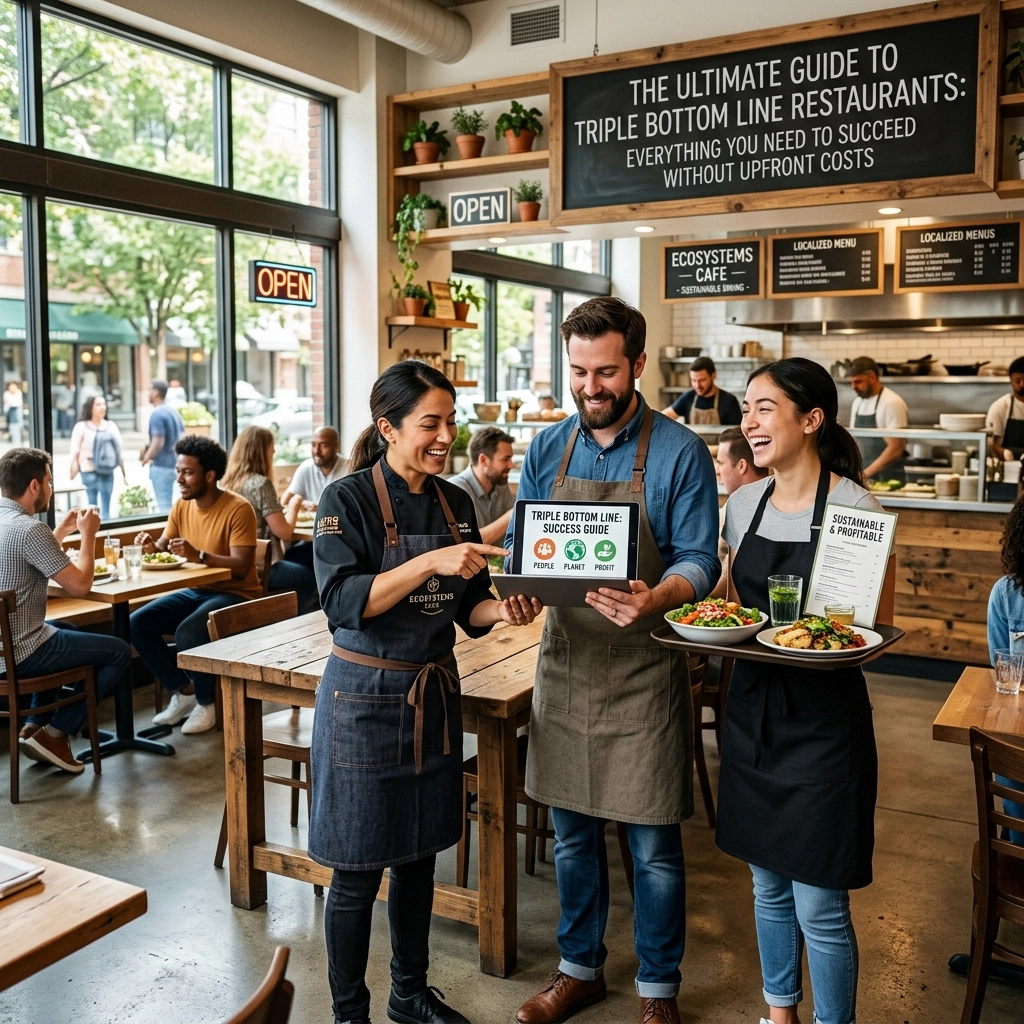
For a long time, the restaurant industry has operated on a pretty simple (and brutal) binary: You either make money, or you’re a charity. If you wanted to "go green," you usually needed a massive capital expenditure budget and a high tolerance for waiting seven years for a return on investment.
But here’s the secret the big chains don’t want you to know: Sustainability isn’t just about saving the turtles; it’s about saving your bank account.
Welcome to the world of the Triple Bottom Line (TBL). In this guide, we’re going to break down how to optimize your restaurant for Profit, People, and the Planet, all while keeping your upfront costs at a big, beautiful zero. At Restaurant Revenue Incubator, we specialize in turnarounds that don't drain your reserves, because we know that if it doesn't make cents, it doesn't make sense.
What is the Triple Bottom Line, Anyway?
The Triple Bottom Line is a business framework that moves beyond the traditional "bottom line" of net income. Instead of just looking at the dollars and cents at the end of the month, you measure your success across three pillars:
- Profit: Financial viability through ethical, efficient practices.
- People: Supporting your staff, your community, and your customers.
- Planet: Minimizing your environmental footprint to ensure long-term resource availability.
Think of it as a stool. If one leg is missing, the whole thing topples over. If you have a planet-friendly restaurant but you’re losing $5,000 a month, you’re going out of business. If you’re making a fortune but your staff quits every three weeks because they're treated like robots, you’re also going out of business (it just takes a little longer).

Pillar 1: Profit (Finding the Hidden Cash in Your Dumpster)
Let's talk about the most important "P" first. You can't save the world if you can't pay rent.
The average restaurant in the United States wastes between 30% and 40% of the food it purchases. Read that again. If you spend $10,000 a week on food, you might be throwing $4,000 directly into the trash. That’s not just bad for the planet; it’s a financial crime.
Menu Engineering for Zero-Cost Gains
You don’t need to buy a $20,000 AI-powered oven to fix this. You need to look at your menu. We call this "Menu Surgery."
- Identify the "Dogs": These are items that are expensive to prep, have a short shelf life, and nobody buys. Kill them today.
- The Multi-Use Ingredient: If an ingredient is only used in one dish, it’s a liability. Every item in your walk-in should have at least three different ways to get onto a plate.
- Portion Control: It sounds basic, but are your line cooks using scales? If they’re "eyeballing" the 6oz steak and giving 7oz, you’re losing 16% of your profit on every single order.
Vendor Hunger Games
When was the last time you audited your suppliers? Many operators stick with the same broadline distributor for years out of habit.
- Buying Cooperatives: Join a local buying group. By pooling your purchasing power with other local spots, you can get the same prices as the national chains.
- Local Farm Partnerships: Sometimes, buying local is actually cheaper because the logistics costs are lower. Plus, telling your customers that the tomatoes came from a farm twenty miles away allows you to charge a premium. Data shows that Millennials and Gen Z are willing to pay up to 15% more for sustainably sourced food.
If your team looks sharp while doing this inventory, they'll feel the professional vibe. Maybe it's time to check out our logo collection for some high-quality gear that fits the brand.
Pillar 2: People (The ROI of a Happy Line Cook)
The restaurant industry has an average turnover rate of over 100%. Every time a trained server or cook walks out the door, it costs you roughly $3,000–$5,000 in recruitment, training, and lost productivity.
Culture is Free
You don't need a massive HR budget to treat people well.
- The "No Jerks" Policy: High-performance cultures are built on psychological safety. When your staff feels respected, they work harder.
- Professionalism as a Perk: Give your staff gear they actually want to wear. A hoodie with logo or a nice polo makes them feel like part of a winning team, not just a cog in a machine.
- Community Capital: Get involved with the local Chamber of Commerce. Sponsor a local youth team. When the community feels "ownership" of your restaurant, they become your best marketing department. This costs nothing but a bit of time and a few pizzas.

Pillar 3: Planet (Efficiency is Just Sustainability in a Suit)
Most people think "Planet" means buying expensive solar panels. In the restaurant world, it mostly means not being wasteful.
The Energy Audit
Restaurants use about 2.5 times more energy per square foot than any other commercial building.
- The Startup/Shutdown Schedule: Do all your ovens need to be on at 8:00 AM if service doesn't start until 11:30? Creating a simple checklist for your openers and closers can save you hundreds on your monthly utility bill.
- Low-Flow Faucets: You can swap out your sink aerators for about $10. This can reduce your water usage by 30%. It’s a tiny cost for a massive, recurring saving.
- The "Ugly" Produce: Start a relationship with a supplier for "seconds": produce that looks a little weird but tastes perfect. It’s significantly cheaper and prevents food from being wasted.
Waste Management
If you're paying a company to haul away your trash, you’re paying for your own inefficiency.
- Composting: In many cities, composting services are cheaper than traditional landfill hauling.
- Oil Recycling: Did you know companies will actually pay you for your used fryer oil? That is literally turning waste into a revenue stream.

Scaling the Sustainable Model
Once you’ve mastered the TBL in one location, you’ve created a "Self-Sustaining System." This is the holy grail of restaurant growth. When your costs are optimized (Profit), your staff is loyal (People), and your waste is minimized (Planet), your margins become so healthy that expansion becomes inevitable.
At Restaurant Revenue Incubator, we focus on this exact scaling process. We look at your tech stack: AI for forecasting, automated inventory, and CRM optimization: to ensure that as you grow, your complexity doesn't kill your soul.
Need a casual look for your next site visit? Grab a cap or some sunglasses from our shop to keep that "Growth & Scaling" energy high.
How to Start Without Spending a Dime
If you’re sitting there thinking, "Penny, this sounds great, but I'm down to my last $500 in the operating account," don't panic. That is exactly where our "No Upfront Cost" turnaround service comes in.
We don't believe in charging struggling restaurants huge consulting fees. That's like charging a drowning person for a life jacket. Instead, we work on a performance-based model. We find the waste, we optimize the labor, we fix the menu, and we share in the new revenue we create for you.
Your 30-Day TBL Challenge:
- Week 1: Perform a waste audit. Literally, look in the bin. If it’s full of prep waste, your cooks need training. If it’s full of plate waste, your portions are too big.
- Week 2: Call three new vendors. Tell them you’re looking to move your business and ask for their best bid on your top 10 most-purchased items.
- Week 3: Host a "Family Meal" where you ask your staff for one idea to make the restaurant better. Listen to them.
- Week 4: Implement a shutdown schedule for all non-essential electronics.

Final Thoughts: The Future is Triple
The "Old School" way of running a restaurant: squeezing staff, ignoring the environment, and hoping for the best: is dying. The future belongs to the operators who realize that being a "good" business is actually the best way to be a "profitable" business.
By focusing on the Triple Bottom Line, you aren't just building a place that serves food; you’re building an institution that serves your community and your future.
If you’re ready to scale your concept or turn around your current operation without the burden of upfront costs, let’s talk. We’ve got the data, the tech, and the "no-nonsense" attitude to get you there. In the meantime, head over to our shop and get yourself a v-neck t-shirt or a beanie. You’ve earned it.
Success in this industry isn't about working harder; it's about working smarter. And there is nothing smarter than making the planet pay you to save it.