Restaurant Technology · Uncategorized
The Definitive 2026 Guide to Food Waste Tech: Leanpath vs Winnow vs Orbisk (and the Regulations That Will Force the Issue)
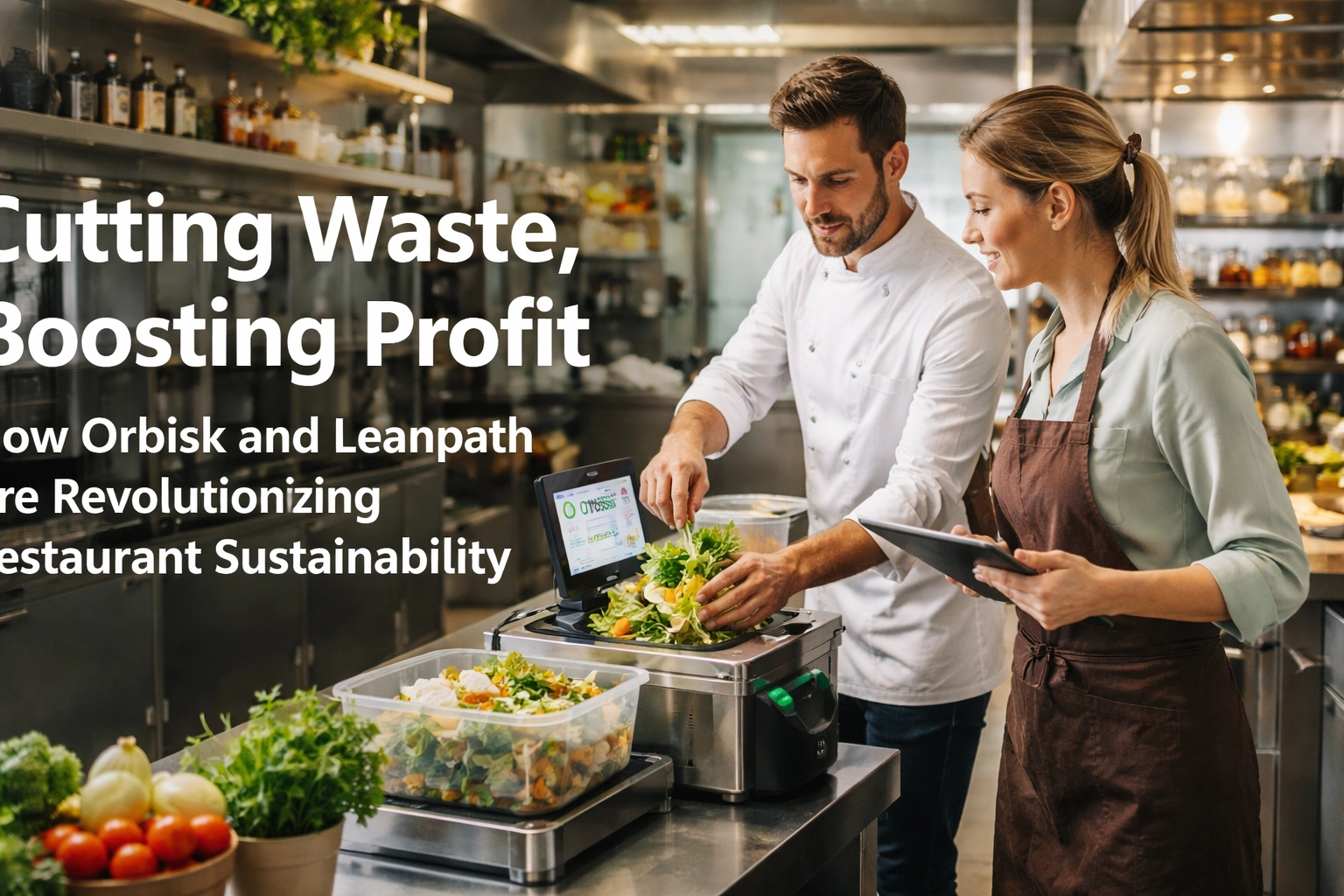
Food waste is one of those problems every operator knows exists… but most restaurants still treat it like a cost of doing business instead of a controllable line item.
And that’s the wild part: food waste is often the biggest “profit leak” hiding in plain sight. Industry estimates routinely put restaurant food waste around 4–10% of purchased food before it ever hits a guest’s plate. That’s not a rounding error. That’s payroll, marketing, or your next unit’s security deposit—quietly being scraped into a bin.
Now add the external pressure: food waste is also a climate issue. The UN/FAO estimates food loss and waste generates roughly 4.4 gigatons of CO₂e per year and if it were a country, it would rank as the #3 emitter behind China and the U.S. That’s why states are turning “sustainability” into “compliance,” with real penalties starting to show up.
So yes—this is a sustainability conversation. But in 2026, it’s also a regulation conversation, a margin conversation, and a leadership conversation.
This master guide covers three leading food waste reduction technologies:
- Leanpath (the coaching pioneer)
- Winnow Vision (the AI powerhouse, especially strong in hotels and large-scale foodservice)
- Orbisk (the plug-and-play agile solution)
Along the way, we’ll go deep on the economics behind triple bottom line restaurants, the psychology of behavior change (including the Hawthorne Effect), and the regulatory landscape that makes 2026 the point of no return for many operators.
If you want a shortcut: at Restaurant Revenue Incubator we’ll review your P&L and your tech stack at no cost, show you where the margin is leaking, and tell you (straight up) whether waste tech is worth it for your concept.
Part 1 — Triple Bottom Line 2.0 for Restaurants (People, Planet, Profit)
The phrase “triple bottom line restaurants” gets tossed around a lot. Let’s make it real, and make it operational.
People: social responsibility in hospitality (and why it’s not fluffy)
Food waste reduction is one of the cleanest ways to bring social responsibility in hospitality into your daily ops without turning your kitchen into a nonprofit.
What “People” looks like in practice:
- Less chaos on the line: over-prep creates clutter, label confusion, and constant rework.
- More pride, less burnout: teams hate throwing out good product. When they see the numbers and the wins, morale improves.
- Better manager coaching: waste data gives your sous chef and GM something concrete to coach to—without opinion wars.
- Edible food recovery: donation workflows become easier when you can identify “safe to recover” product earlier (and document it).
Big picture: waste tech is often the first sustainability initiative that actually gets staff buy-in because they see the waste with their own eyes.
Planet: the carbon math is not optional anymore
Food waste isn’t just “trash.” It’s embedded emissions from:
- farming
- refrigeration
- transport
- prep labor
- cooking energy
- landfill methane (if it ends up there)
Core stat worth remembering:
- The UN/FAO estimates food loss and waste generates roughly 4.4 gigatons of CO₂e annually (and again—“#3 emitter” framing is widely cited).
For operators, this matters because:
- corporate clients are demanding sustainability reporting
- municipalities are tightening organics rules
- landlords and RFPs increasingly ask for diversion plans
This is why “eco-friendly restaurant profit” is no longer a contradiction. The same actions that cut waste usually cut cost and risk.
Profit: the part everyone cares about (and the math is brutal)
This is where restaurant sustainability cost savings becomes measurable.
The 5% recovery rule: how small waste reductions create big profit jumps
Here’s the cleanest way to explain it to an operator:
Most restaurants run on thin net margins (often 3–8% depending on concept, debt, and rent). Food is usually 25–35% of sales.
If you recover 5% of food spend, that’s roughly:
- 5% of (say) a 30% food cost = 1.5% of sales dropping straight to the bottom line (assuming you don’t give it back in new waste elsewhere).
For a restaurant doing $2,000,000 in annual sales:
- 1.5% of sales = $30,000/year in profit improvement.
If your net margin was 5% ($100,000), you just increased net profit by 30%.
That’s why it’s totally reasonable to say: recovering ~5% of food spend can increase net profit 20–30% for a typical restaurant. And in some cases, it’s more.
That’s the economics behind sustainable kitchen operations done correctly: fewer purchases, less prep, less hauling, fewer 86’s, better forecasting, and cleaner execution.
Part 2 — The Hidden Engine: Behavior Change (Why Tracking Alone Cuts Waste 20%+)
Before we compare Leanpath vs Winnow vs Orbisk, we need to talk about the part nobody wants to admit:
Most waste programs fail because people don’t change. They install a “system”… and then the system becomes wallpaper.
The Hawthorne Effect: why observation changes behavior (even before you optimize)
The Hawthorne Effect is simple: when people know they’re being observed (or measured), they change their behavior.
In kitchens, that plays out like this:
- the second you put a scale + camera at the bin, staff slows down and thinks
- “Is this trim necessary?”
- “Do we really need to toss this pan?”
- “Why did we over-prep again?”
That’s why many operators see immediate improvement even before they do a single menu change. In real-world terms, tracking alone can drive 20%+ reductions in waste for many kitchens because it forces awareness.
The difference between a gadget and a profit center
If you want waste tech to print money, you need three things:
-
Visible scoreboards
Waste per cover, top 5 wasted items, and weekly dollars wasted—posted where prep happens. -
Rituals (not “training”)
- 5 minutes in pre-shift, 2–3x/week: “What got wasted yesterday and why?”
- weekly manager review: top item, root cause, corrective action
- monthly menu/ordering tweaks
-
Ownership
One person is accountable (usually KM/chef + GM). Not “everyone,” not “no one.”
Waste tech works when it becomes part of your leadership cadence, not an app someone checks once a month.
Part 3 — The Big 3 Food Waste Technologies (Hardware + AI + Workflow)
All three systems are trying to solve the same problem: make food waste visible, measurable, and actionable—fast enough that you can change tomorrow’s prep, not next quarter’s.
But they do it differently.
1) Leanpath (the coaching pioneer)
Positioning: Leanpath is the “operations + coaching” heavyweight. It’s known for pairing tools with a change-management approach.
Typical setup (high-level):
- Hardware: a food waste tracking station (commonly referenced as a bench scale setup) designed for back-of-house workflows.
- Data capture: staff records waste at the station; system captures weight and categorization and supports photo-based recognition depending on configuration/workflow.
- Software: dashboards that show waste by item, reason, station, time, and cost impact.
- Human layer: ongoing coaching and structured programs to drive adoption.
Where Leanpath tends to win:
- multi-unit groups that need standard operating rhythms
- chef-driven kitchens where “why” matters and culture is everything
- operators who want hands-on guidance (and accountability)
Typical ROI:
Operators often report strong returns; in the market, you’ll see ROI ranges discussed across systems broadly from 2x to 14x, depending on baseline waste, concept complexity, and adoption.
Implementation speed:
Moderate. Strong onboarding, but it’s not “open box, done.” The payoff is usually better long-term stickiness.
Pricing model (typical market pattern):
- subscription SaaS + hardware (sometimes bundled), often with coaching services included or available as an add-on
2) Winnow Vision (the AI powerhouse, especially in hotels)
Positioning: Winnow Vision is the “AI at scale” option and is widely associated with hotels, resorts, and large foodservice—places with high volume, big buffets, banquet production, and lots of SKUs moving fast.
Typical setup (high-level):
- Hardware: camera + scale station (Vision system) placed where waste is binned (prep waste, buffet returns, banquets).
- AI software: strong image recognition for identifying what’s being wasted, with minimal staff input.
- Outputs: waste by item, station, time, and cost—often packaged for enterprise reporting.
Where Winnow tends to win:
- hotels/resorts (multiple outlets, banquets, buffets)
- contract foodservice / institutional scale
- brands that care about centralized reporting and standardization
Typical ROI:
- commonly positioned as strong ROI when volume is high and the waste stream is “big enough to matter daily”
- again, ROI across these systems is often discussed in a wide band like 2x–14x depending on the starting point and adoption
Implementation speed:
- moderate; the tech is powerful, but the environment is complex (multiple outlets and stakeholders)
Pricing model (typical market pattern):
- usually SaaS subscription with hardware as part of the package or a separate line item depending on contract structure
3) Orbisk (the plug-and-play agile solution)
Positioning: Orbisk is often seen as the “fast deployment” option—designed to be easy for teams to adopt without creating friction in already-stressed kitchens.
Typical setup (high-level):
- Hardware: smart camera + scale
- Automation focus: capture happens with minimal manual steps
- Software: dashboard built for fast insight (waste per cover, top waste categories, time-based patterns)
Where Orbisk tends to win:
- fast-casual and high-volume kitchens where speed matters
- single units and small groups that want quick wins
- teams that don’t have bandwidth for heavy process change
Typical ROI:
- Orbisk publishes and operators report meaningful waste reductions; ROI is often framed in that broader 2x–14x band across the category, heavily dependent on baseline waste and adoption quality.
Implementation speed:
- fast. This is a key selling point.
Pricing model (typical market pattern):
- typically subscription SaaS + hardware (often packaged)
Part 4 — Comparison & Contrast (Leanpath vs Winnow vs Orbisk)
Let’s make this practical. Same goal, different strengths.
At-a-glance comparison
| Category | Leanpath | Winnow Vision | Orbisk |
|---|---|---|---|
| Best fit | Ops-heavy restaurants + groups that want coaching | Hotels, resorts, large-scale foodservice | Single units / small groups needing quick adoption |
| Core edge | Change management + structured coaching | AI recognition at scale | Low-friction, plug-and-play workflows |
| Level of automation | Medium (workflow dependent) | High | High |
| Implementation speed | Medium | Medium | Fast |
| Management time required | Medium (but structured) | Medium (multi-outlet complexity) | Lower |
| Reporting | Strong operational dashboards | Strong enterprise reporting | Strong “actionable now” dashboards |
| ROI range discussed in market | 2x–14x depending on baseline/adoption | 2x–14x depending on baseline/adoption | 2x–14x depending on baseline/adoption |
| Pricing models | SaaS + hardware; coaching often included/available | SaaS + hardware (contract-dependent) | SaaS + hardware (often bundled) |
Ease of use
- Easiest day-one: Orbisk
- Easiest with complex teams: Winnow (once placed correctly), but it’s usually in complex operations
- Easiest long-term adoption (because of coaching): Leanpath if you actually lean into the program
Level of automation (what does the team have to do?)
- Winnow Vision: generally the strongest “AI identifies the item” story at volume
- Orbisk: strong automation + fast feedback loops
- Leanpath: depends on workflow and configuration; the big value-add is pairing measurement with coaching
Price models (SaaS vs upfront)
Real talk: pricing varies by contract size, geography, and service levels. But operators usually see some version of:
- SaaS subscription (monthly/annual) for software + support
- Hardware either bundled into subscription, leased, or purchased upfront
- Onboarding/coaching either included or added as a services line item
So when you evaluate “price,” don’t just ask “what’s the monthly fee?” Ask:
- What’s included in onboarding?
- Who trains staff?
- Who helps interpret data into action?
- What happens at month 3 when adoption drops?
Part 5 — Decision Matrix: How to Choose the Right Tool
Here’s a practical decision matrix. Score each from 1–5 based on your reality.
Step 1: Decide what problem you’re actually solving
Most operators think they need “waste tracking.” What they really need is one of these:
- Compliance readiness (organics diversion + donation documentation)
- Food cost reduction (prep waste + overproduction)
- Buffet/banquet control (hotels)
- Culture reset (new chef, turnaround, margin collapse)
Step 2: Use the matrix
| Your situation | Leanpath | Winnow Vision | Orbisk |
|---|---|---|---|
| “We need staff behavior change and accountability” | 5 | 3 | 4 |
| “We’re a hotel/resort with buffets + banquets” | 3 | 5 | 3 |
| “We need the fastest possible rollout” | 3 | 3 | 5 |
| “We’re a chef-driven concept and want coaching” | 5 | 3 | 4 |
| “We’re fast-casual and low bandwidth” | 3 | 3 | 5 |
| “We’re a multi-unit group that needs standardization” | 5 | 5 | 4 |
| “We want heavy automation, minimal manual input” | 3 | 5 | 5 |
Step 3: The tie-breakers that actually matter
If you’re stuck between two:
- Choose the one your team will actually use every day.
- Choose the one that fits your workflow without creating a choke point at the trash station.
- Choose the one with support that matches your leadership bench (because software can’t coach people).
Part 6 — The Regulatory Landscape (Why 2026 Is the Point of No Return)
This is the part most restaurants are behind on.
Food waste regulation used to be “mostly for big generators.” That’s changing. Thresholds are dropping, enforcement is tightening, and reporting requirements are expanding.
California: SB 1383 (the one everyone cites)
California SB 1383 targets short-lived climate pollutants (methane from organics). Key requirements widely cited in compliance guidance include:
- 75% reduction in organic waste disposal by 2025 (statewide target)
- 20% edible food recovery by 2025 (commercial edible food that would otherwise be disposed)
- Enforcement and fines: jurisdictions began enforcement and can issue penalties, with 2024+ widely referenced as the period when enforcement tightens and fines become real.
Practical implication: if you operate in CA (or plan to), you need:
- a diversion plan
- donation partnerships (where applicable)
- documentation and tracking discipline
Waste tech can support compliance by creating:
- measurement
- categorization
- documentation rhythms
…but it won’t replace required contracts or hauling setups.
New York State: Food Donation and Food Scraps Recycling Law (thresholds dropping)
New York State’s Food Donation and Food Scraps Recycling Law has been expanding. NYSDEC guidance notes that:
- the threshold drops to 1 ton per week starting in 2027 (from the prior 2 tons per week threshold), with additional reductions planned later.
Practical implication: more mid-sized operators will be pulled into compliance, especially groups and high-volume independents.
Massachusetts: commercial food waste disposal ban (0.5 tons/week)
Massachusetts’ Commercial Food Material Disposal Ban applies to entities generating more than one-half ton per week of food material (MassDEP guidance reflects this threshold).
Practical implication: if you’re a higher-volume restaurant, commissary, or group kitchen in MA, you’re probably already in scope.
Vermont: 100% landfill ban since 2020
Vermont’s Universal Recycling Law (Act 148) culminated in a statewide ban on disposing of food scraps in landfills/trash as of 2020.
Practical implication: Vermont operators are already living in the “future,” and other states are moving in that direction.
Connecticut: upcoming 2026 mandates (expanding scope)
Connecticut’s Commercial Organics Recycling Law (CORL) continues to expand. State resources and related guidance reflect:
- broader reporting expectations beginning 2025 (for prior year activity)
- expanded requirements in 2026 affecting additional generator categories (including schools under certain conditions), and continued tightening of diversion expectations
Practical implication: if you operate in CT, expect increased attention on:
- tracking what you generate
- where it goes (donation vs recycling vs disposal)
- documentation
Why 2026 is the point of no return
Because by 2026:
- enforcement is no longer theoretical (fines, inspections, reporting)
- thresholds in multiple states are low enough to capture more restaurants
- major customers (corporate, institutional, hotel groups) will demand reporting upstream
Translation: waste reduction is shifting from “nice story” to “operational requirement.” That’s exactly why restaurant sustainability cost savings and compliance are now tied together.
Part 7 — Implementation That Actually Works (Training + Culture + Cadence)
Tech is only half the equation. Here’s the playbook.
Staff training: what to train (and what not to)
Don’t train your team on “the platform.” Train them on:
- where to dump waste (one station, consistent)
- what categories matter (keep it simple)
- what “reasons” mean (overproduction, spoilage, trim, expired, returned, etc.)
- what success looks like (waste per cover targets)
Training format that works:
- 15 minutes at lineup
- 2-minute refresher during pre-shift for the first 2 weeks
- one “waste captain” per shift who owns compliance
Culture change: make waste visible, then make it competitive
A simple culture flywheel:
- Pick one KPI: waste dollars/week or waste per cover
- Publish it weekly
- Pick one item to attack weekly (top waste item)
- Celebrate reductions publicly (and tie it to real outcomes)
Manager cadence (the part that creates sustained ROI)
- Daily: quick check the station is used correctly
- Weekly: 20-minute waste review (chef + GM)
- Monthly: purchasing + menu adjustment meeting
- Quarterly: re-baseline, reset targets, update training
That’s how sustainable kitchen operations turn into durable margin.
Part 8 — Getting Started (and where Restaurant Revenue Incubator fits)
If you’re thinking about Leanpath vs Winnow vs Orbisk, start here:
Step 1: Know your “waste profile”
- Are you wasting in prep, overproduction, or plate waste?
- Is the issue ordering, execution, forecasting, or menu design?
Step 2: Do the profit math (quick and dirty)
- Estimate food purchases per month
- Assume 4–10% waste
- Model savings at 20%, 40%, and 60% reduction
- Compare to subscription + hardware cost
If you want help, this is exactly the kind of analysis we do through our free P&L reviews.
Step 3: Audit your tech stack (before you buy another tool)
Waste tech is powerful, but it’s not isolated. It touches:
- inventory systems
- ordering workflows
- recipe management
- prep systems
- POS/menu engineering
At Restaurant Revenue Incubator, we do tech stack audits at no cost and call out where:
- data is missing
- tools overlap
- workflows are broken
- “new tech” would fail because the fundamentals aren’t in place
Step 4: Decide what kind of partnership you want
One last point, because it matters:
If you want a partner that goes beyond recommendations and actually helps you capture the savings, that’s our lane. We run a risk-free model: we only ask for a share of the results we create, rather than upfront retainers. And if you’re in a pinch, we can often help turn a business around in under 2 weeks—free.
The Bigger Picture (aka: the simplest truth)
Waste reduction is one of the few initiatives where:
- the planet wins
- your team wins
- your P&L wins
That’s why triple bottom line restaurants are going mainstream. Not because it’s trendy—but because it’s financially rational and increasingly non-negotiable.
If you want to pressure-test which system fits your concept (or whether you should even buy one yet), start with a free P&L + tech review. We’ll tell you where the real opportunity is—no fluff.
Ready to cut waste, improve compliance readiness, and unlock eco-friendly restaurant profit? Visit Restaurant Revenue Incubator to request a free P&L review and tech stack audit.