Restaurant Technology · Uncategorized
How to Integrate AI With Sustainable Kitchen Operations (and Stop Trashing Your Margins)
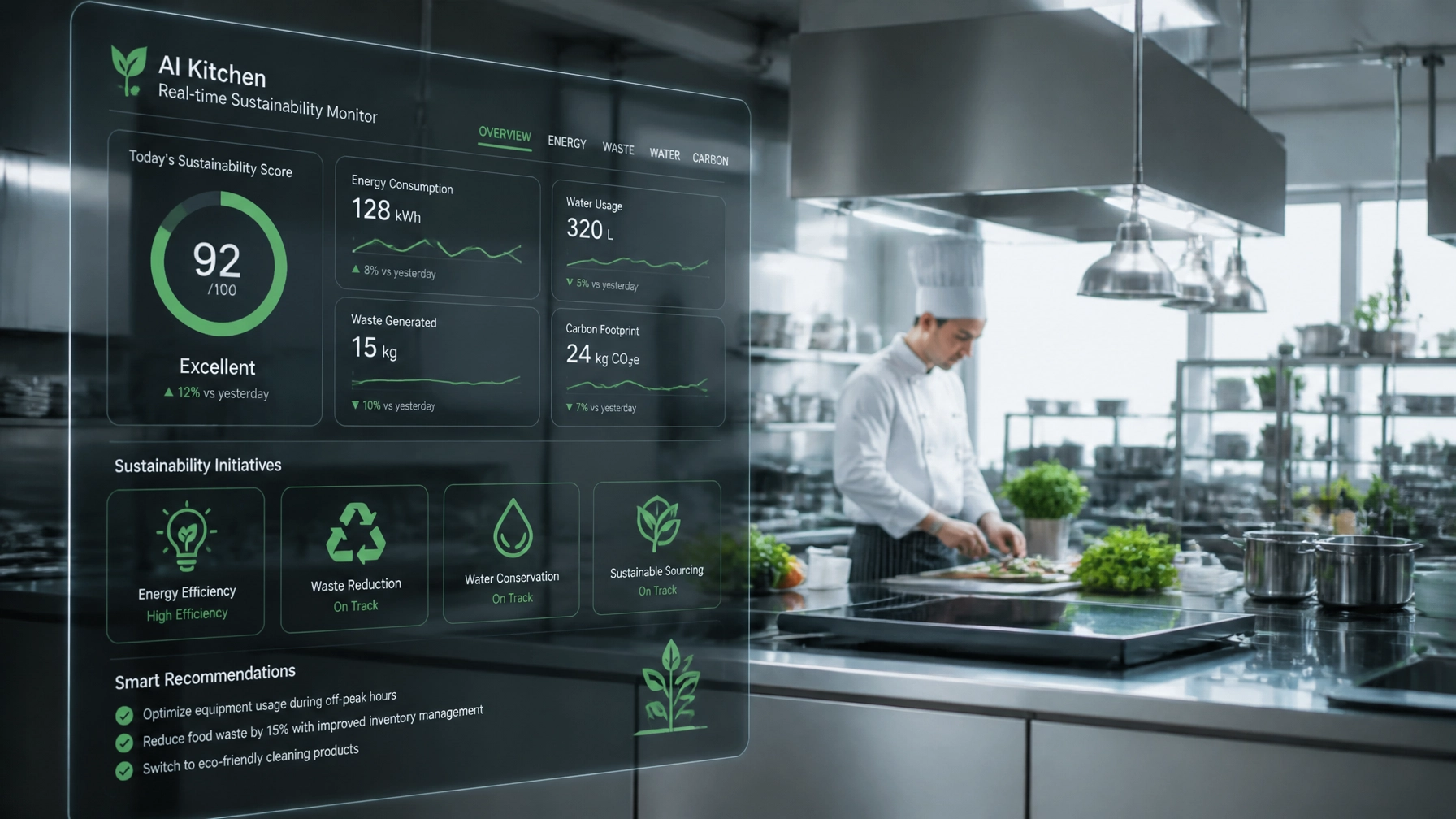
Let’s be honest: in the restaurant world, "sustainability" used to be a dirty word for many operators. It sounded like an expensive hobby, something you did if you had a Michelin star and a vegetable garden, or if you were a massive corporate chain trying to win some PR points. For the rest of us, trying to survive on 5% margins, buying organic compostable straws felt like a fast track to bankruptcy.
But the game has changed. Today, sustainability isn't just about saving the turtles (though we like them too); it’s about saving your P&L. We’re entering the era of the Triple Bottom Line: People, Planet, and Profit. And the secret weapon making it possible? Artificial Intelligence.
If you’re still running your kitchen on "gut feelings" and paper prep lists, you aren't just behind the curve, you’re literally throwing money in the bin. Here’s how to integrate AI into your operations to create a sustainable, high-margin machine without the upfront headache.
The Triple Bottom Line: Why "Going Green" is Finally Profitable
For a long time, the industry looked at sustainability as a cost. At Restaurant Revenue Incubator, we look at it through the lens of the Triple Bottom Line. When you use AI to optimize your kitchen, you aren't just checking a box for sustainability certifications; you’re attacking your three biggest problems:
- People: AI reduces the "grind" of soul-crushing inventory and mindless prep, letting your staff focus on what they actually enjoy, cooking and hospitality.
- Planet: You stop over-ordering food that ends up in a landfill and burning energy in a half-empty dining room.
- Profit: This is the big one. Every pound of food waste you eliminate is straight profit. Every kilowatt of energy saved is a reduction in overhead.

1. Killing the "Bin Ghost": AI-Powered Food Waste Management
Food waste is the silent killer of restaurant margins. On average, kitchens waste 4% to 10% of the food they buy before it even reaches a plate. If your food cost is 30%, that’s a massive chunk of your revenue literally going into the trash.
Enter AI waste trackers like Winnow, Leanpath, and Orbisk. These aren’t just fancy scales; they are computer-vision systems. They use cameras mounted above your bins to "see" what is being thrown away.
- How it works: When a prep cook scraps half a head of wilted lettuce, the AI identifies it, weighs it, and logs the cost.
- The Result: You get a report at the end of the week that says, "Hey, you wasted $400 on tomatoes this week because your morning prep team is over-calculating demand."
Operators using these tools typically see a 50% reduction in food waste. That’s not just a win for the planet; it’s a massive injection of liquidity back into your business. If you've ever wondered how tech has saved the day, this is a prime example.

2. Demand Forecasting: Stop Buying What You Won’t Sell
Most restaurants order food based on what they sold last week. But AI looks at everything: the weather (it’s raining, so people want soup, not salads), local events (there’s a concert down the street, expect a 20% spike), and historical seasonality.
By using AI-driven inventory platforms, you can move from "reactive ordering" to "predictive ordering." This keeps your inventory lean, reduces spoilage, and ensures you aren't tied up in "dead stock" sitting on your shelves. In an industry where delivery apps have squeezed margins to the breaking point, this level of precision isn't a luxury: it's a survival tactic.
3. The Energy Drain: AI for "Smart" Facilities
Have you ever walked into your restaurant at 10:00 AM and realized the HVAC has been blasting at 68 degrees in an empty dining room since the cleaners left at 4:00 AM? Or that your walk-in fridge's compressor is working overtime because a gasket is slightly loose?
AI-integrated building management systems (BMS) monitor these patterns in real-time. They can automatically adjust lighting and temperature based on occupancy and even predict when a piece of equipment is about to fail before it actually dies (and ruins $5,000 worth of Wagyu). Reducing energy consumption by even 15% can significantly impact your bottom line, proving that green initiatives are, at their core, cost-saving initiatives.
4. Menu Engineering with a Brain
AI doesn’t just look at what sells; it looks at what is profitable and sustainable. By cross-referencing your sales data with your waste data and ingredient costs, AI can suggest menu tweaks.
Maybe your "Signature Seafood Platter" has a high margin but creates 30% plate waste because the portion is too large. Or maybe your plant-forward pasta has a lower ingredient cost and higher customer satisfaction rating. AI helps you "nudge" customers toward the dishes that are best for your Triple Bottom Line.

The Catch: "I Don't Have the Budget for This"
This is where most restaurant owners stop. They see the price tag for a full tech stack overhaul and go back to their spreadsheets. We get it. The industry is capital-intensive, and the last thing you want is another monthly SaaS fee or a $20,000 equipment bill.
That’s where Restaurant Revenue Incubator comes in.
We don’t believe you should have to pay upfront to fix a broken business. We offer no-cost P&L and tech stack reviews. We look at your operations, identify where the "bleeding" is happening, and implement these AI and sustainability solutions for you.
Our model is simple: We only ask for a share of the results we create. No upfront retainers, no interest, no equity dilution. We even have partners who provide capital in exchange for food & beverage credits: meaning you get the funding you need to scale without taking on traditional debt.
Scaling the Sustainable Way
If you’re looking to scale from one unit to five, or from a local favorite to a regional franchise, you cannot do it on manual systems. Scaling "messy" operations only scales the mess. By integrating AI and sustainability now, you build a foundation that is lean, efficient, and attractive to investors.

Sustainability is no longer a "nice to have." It is the most effective way to protect your margins in a high-cost environment. Whether it's through cutting food waste with computer vision or optimizing your labor spend with predictive scheduling, the tech is here to help you win.
Ready to see what AI can do for your margins? Stop trashing your profits and let us do a free deep-dive into your tech stack. We’ve turned businesses around in under two weeks: at no upfront cost to the operator.
Get your free P&L review today.