Restaurant Technology · Uncategorized
The Ultimate Guide to Restaurant Sustainability Cost Savings: How to Turn Green Into Gold in 14 Days
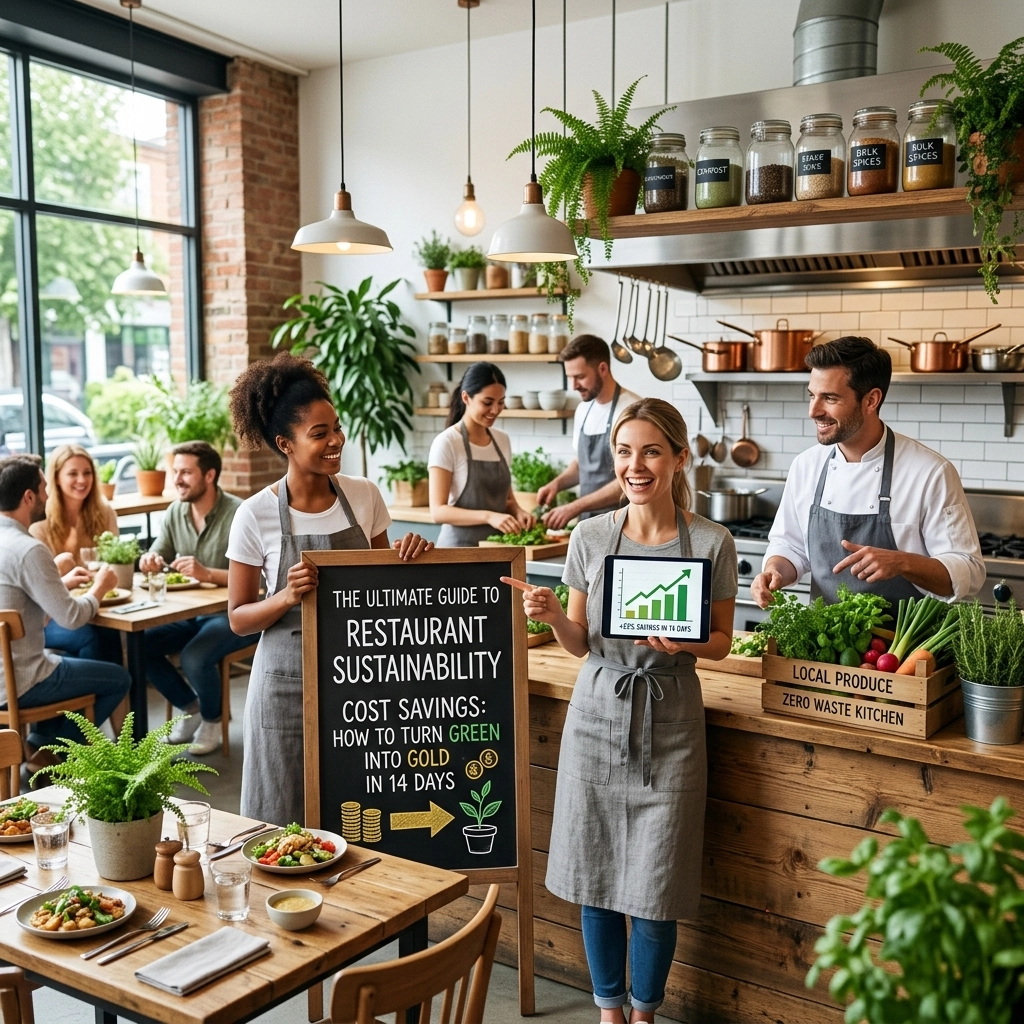
Let’s be honest: when most restaurant owners hear the word “sustainability,” they don’t think about saving the planet. They think about spending money they don’t have on solar panels or artisanal, hand-massaged kale that costs $45 a pound.
But I’m here to tell you that "going green" isn't a charity project for your business. It’s a profit-generating machine. At Restaurant Revenue Incubator, we view sustainability through the lens of the Triple Bottom Line: People, Planet, and Profit. If an initiative doesn't eventually lead back to that third "P," it’s probably not a sustainable business move.
The best part? You don't need a massive capital injection to start. In fact, our specialty is the "No Upfront Cost" turnaround. We find the leaks in your bucket, plug them with tech and efficiency, and use the found money to scale your concept.
Here is your 14-day roadmap to turning your restaurant into a lean, green, profit-making machine.
Week 1: The Low-Hanging Fruit (Days 1–7)
The first week is about stopping the bleeding. We aren't rebuilding the kitchen yet; we’re just making sure you aren't literally throwing cash into the dumpster.
Day 1–3: The Food Waste Audit
If you aren't tracking your food waste, you’re essentially running a restaurant with a hole in your pocket. Research shows that for every $1 invested in reducing kitchen food waste, restaurants save an average of $7 to $8 in operating costs. That is an ROI that would make a Wall Street hedge fund manager weep.
Start by categorized waste:
- Prep Waste: Scraps that could be used for stocks or garnishes.
- Spoilage: Food that died in the walk-in because someone forgot the "First In, First Out" (FIFO) rule.
- Plate Waste: What your customers leave behind (usually a sign of portion-size issues).

Day 4–5: The Great Lighting Swap
This is the easiest win in the book. If you’re still using old-school incandescent or fluorescent bulbs, you’re heating your restaurant with your light fixtures. Switching to LED lighting uses up to 75% less energy and the bulbs last longer than some of my previous relationships.
Pair these with occupancy sensors in low-traffic areas like storage rooms and walk-ins. There is no reason for the potato storage room to be lit up like a Broadway stage 24/7 when nobody is in there.
Day 6–7: Staff Training & Buy-In (The "People" Factor)
Sustainability fails without your team. If your line cook leaves the burner on "high" for four hours because "that's how we've always done it," your profit is evaporating.
Explain the Triple Bottom Line to them. When the restaurant is more profitable, there is more money for raises, better equipment, and growth. Heck, buy the team some high-quality beanies or logo tees to build that culture of pride. When the team feels like they are part of a mission: not just a shift: retention skyrockets.
Week 2: Systems and Optimization (Days 8–14)
Now that we’ve handled the basics, it’s time to look at the "hidden" costs: the utilities and systems that run in the background.
Day 8–10: Water Conservation & Maintenance
Water bills are the "silent killer" of restaurant margins. Install low-flow faucet aerators and high-efficiency spray valves. These cost about $20–$50 and can save thousands over a year.
Also, look at your equipment maintenance. A dirty refrigerator coil makes the motor work 20% harder. That’s 20% more electricity for the exact same amount of cooling. It’s like trying to run a marathon while breathing through a cocktail straw. Clean your coils, check your gaskets, and watch the utility bill drop.
Day 11–12: Smart Controls and Tech Integration
This is where we get into the full tech stack leadership. Implementing an Energy Management System (EMS) allows you to control HVAC and refrigeration via a mobile app.
Imagine being able to see that your AC is fighting the heat of the ovens at 3:00 PM and adjusting it remotely to optimize for "Peak Demand" charges. Most utility companies charge more during peak hours. If you can shift your energy-heavy tasks (like running the dishwasher or prepping in the walk-in) to off-peak times, you win.

Day 13–14: Menu Engineering for the Planet
By Day 13, you have the data from your Day 1 waste audit. Use it.
- Are people consistently leaving the side of coleslaw? Remove it or make it an add-on.
- Are you buying out-of-season produce that costs a fortune to ship? Switch to local, seasonal items.
Local sourcing isn't just a marketing buzzword; it reduces "food miles," which lowers your carbon footprint and often lowers your procurement costs because you aren't paying for a truck to drive a tomato across three time zones.
Beyond 14 Days: Scaling the Green
Once you’ve stabilized your current operations, it’s time to think about long-term scaling. At Restaurant Revenue Incubator, we don’t just want you to have one efficient restaurant; we want you to have a scalable empire.
Solar and Long-Term Assets
While solar panels have a longer payback period (usually around 7 years), they provide free electricity for the following 23 years. If you own your building or have a long-term lease, this is a "no-brainer" for long-term profit stability.
The Triple Bottom Line as a Growth Strategy
When you operate sustainably, you attract two things every restaurant needs:
- Top-tier Talent: Gen Z and Millennial workers want to work for companies that give a damn.
- Loyal Customers: Data shows that consumers are increasingly choosing brands based on their environmental and social impact.

Turning "Green" into "Gold" with No Upfront Cost
The biggest barrier to these changes is usually the initial "hustle" and the fear of the price tag. That’s where we come in. Our "No Upfront Cost" turnaround services are designed to identify these exact efficiencies for you.
We don't ask you for a giant check. Instead, we optimize your tech stack, streamline your leadership, and implement these sustainability measures. We take our fee from the new revenue and savings we generate for you. If we don’t make you more money, we don't get paid. It’s the ultimate win-win.
Whether you're looking to tighten up a single location or you're ready to scale your concept to 50 units, sustainability is the foundation. Efficiency is just "sustainability" with a better haircut.
Final Thoughts
Saving the planet is great, but saving your restaurant is our primary mission. By following this 14-day guide, you aren't just being "eco-friendly": you're being a smarter operator.
Ready to see how deep the rabbit hole goes? Check out our shop for some team gear to kick off your new culture, or dive into our tech stack optimization guide to start your 14-day transformation.

Let’s turn that "green" into actual gold.
: Robert, Affiliate Booster at Restaurant Revenue Incubator