Restaurant Technology · Uncategorized
Eco-Friendly Restaurant Profit: Why Triple Bottom Line Restaurants Are Actually Outpacing the Competition
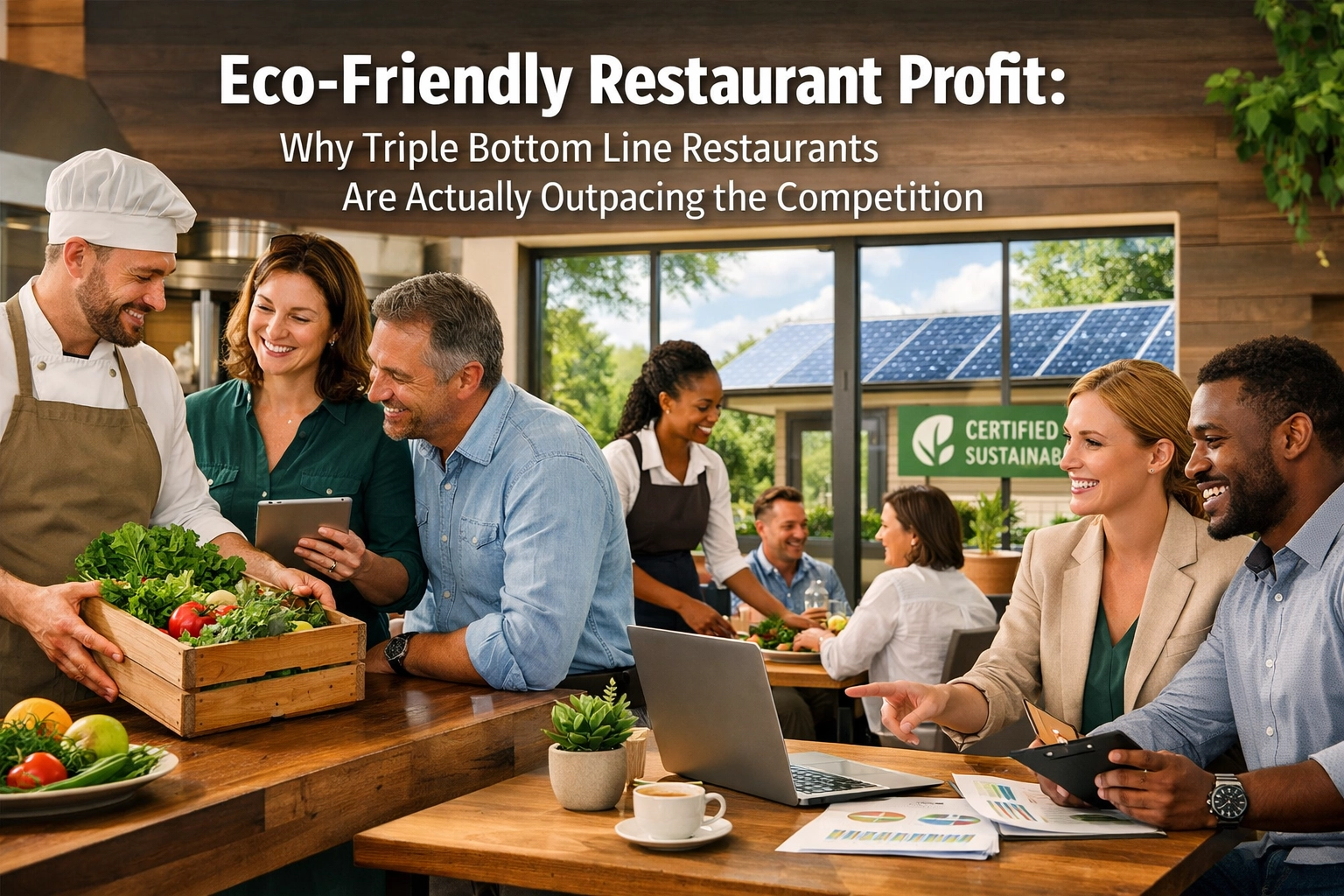
For a long time, "sustainability" in the restaurant industry was treated like that one gluten-free, vegan, nut-free muffin on the menu: something you kept around to be polite, even if it didn't really move the needle on your bottom line. Owners often viewed eco-friendly practices as a luxury or, worse, a tax on their already razor-thin margins.
But the data is coming in, and it’s telling a very different story.
At Restaurant Revenue Incubator, we’ve seen the shift firsthand. Sustainability isn't just about saving the whales or feeling good about your carbon footprint; it’s about tactical, aggressive revenue optimization. In fact, the "Triple Bottom Line": a framework that focuses on People, Planet, and Profit: is becoming the secret weapon for restaurants that are currently outpacing their competition.
If you think going green is too expensive, you’re looking at the wrong ledger. Let’s dive into why being eco-friendly is the most profitable decision you can make in 2026.
The $7 Miracle: The ROI of Sustainability
Let’s start with the hard numbers because, at the end of the day, if the math doesn’t work, the doors don't stay open. Recent research has uncovered a staggering statistic: for every $1 a restaurant invests in sustainability initiatives, they see an average return of $7 in profit.
That is a 600% ROI. In an industry where a 10% net profit margin is considered a massive win, ignoring a 7-to-1 return is practically financial malpractice.
This isn't magic; it’s the result of several converging factors. When you optimize for the "Planet," you are inherently optimizing for efficiency. Whether it’s reducing energy consumption, streamlining your supply chain, or tackling the "hidden monster" of food waste, every green initiative is a direct assault on your P&L’s biggest expenses.

Stop Setting Your Dumpster on Fire
If you want to find your lost profit, start by looking in your trash can.
The restaurant industry generates approximately 12.7 million tons of surplus food annually. To put that in perspective, that’s about $162 billion in waste-related costs: including the cost of the food itself, the labor used to prep it, the packaging it came in, and the fees you pay to have it hauled away.
Think about that: you are literally paying people to take your money to a landfill.
By implementing food waste reduction programs, restaurants have seen a 26% average reduction in food waste within a single year. More importantly, 75% of those businesses recouped their initial investment in record time. At Restaurant Revenue Incubator, we specialize in cost reduction strategies that turn these waste streams back into cash flow.
Whether it's using AI-driven inventory tracking to prevent over-ordering or getting creative with "root-to-stem" cooking (where that broccoli stalk becomes a high-margin slaw rather than trash), the savings are immediate.
The Conscious Consumer: Why They’ll Pay More for "Green"
While you’re busy saving money on the back end, your customers are ready to give you more money on the front end.
The modern diner is no longer just looking for a meal; they are looking for alignment. Data shows that 68% of diners believe restaurants should incorporate sustainability practices, and 50% of consumers are actively choosing restaurants based on their environmental footprint.
But here is the real kicker: sustainability gives you pricing power.
The average price premium for environmentally sustainable meals is roughly 20%. Most consumers are willing to pay at least 10% more if they know the restaurant is sourcing locally, reducing plastic, or treating its staff fairly. In a world of rising commodity costs, that 10-20% "sustainability premium" is the difference between struggling and scaling. This is a core component of driving new customers to your brand.

The "People" Pillar: Retention in a Labor Crisis
The Triple Bottom Line isn’t just about solar panels and compost bins; it’s about People.
The restaurant industry has long struggled with a labor crisis. Burnout is real, and turnover is expensive. However, restaurants that lean into the Triple Bottom Line often find it much easier to attract and retain top-tier talent.
Younger generations: the bulk of the hospitality workforce: want to work for companies that have a purpose beyond just turning a profit. When your staff feels like they are part of a mission: whether that’s supporting local farmers or reducing community hunger through food rescue programs: job satisfaction skyrockets.
Reduced turnover means reduced training costs. It means more consistent service. It means a better culture. If you’ve ever wondered about the work-life balance in the restaurant industry, you know that a stable, motivated team is worth its weight in gold.
Scaling the Green Concept
One of the biggest myths we hear at Restaurant Revenue Incubator is that "green doesn't scale." The logic is that once you grow to 5, 10, or 50 locations, the logistics of local sourcing and waste management become too complex.
The reality? It’s actually easier to be sustainable at scale.
As you grow, your purchasing power increases. You can negotiate better rates for compostable packaging. You can implement centralized AI systems to monitor energy usage across all units. You can create a closed-loop system that smaller "mom and pop" shops could only dream of.
Sustainability is the ultimate foundation for growth. It builds a brand that is resilient to price fluctuations in the global food market and a customer base that is fiercely loyal.

Technology: The Enabler of the Triple Bottom Line
You can't manage what you don't measure. This is where the intersection of sustainability and Restaurant Tech becomes vital.
We are seeing a revolution in "Green Tech" for kitchens:
- AI-Driven Ordering: Systems that predict exactly how much sourdough you need for a Tuesday lunch based on weather, local events, and historical data, virtually eliminating over-prep.
- Smart HVAC & Refrigeration: Sensors that alert you the moment a walk-in cooler door is left ajar or a compressor is failing, saving thousands in energy and spoiled inventory.
- Automated Waste Tracking: Cameras and scales that sit over your prep bins to identify exactly what is being thrown away and why.
If you’re not utilizing these tools, you’re leaving money on the table: and likely on the floor.
The "No Upfront Cost" Turnaround
We get it. You’re running a restaurant. You’re dealing with a broken dishwasher, a server who called out, and a food distributor who just hiked prices again. The idea of "going green" might feel like one more thing on an impossible to-do list.
That’s where Restaurant Revenue Incubator comes in.
We don't believe you should have to pay a fortune to save your business. We offer "No Upfront Cost" turnaround services. Our model is simple: we identify the leaks in your bucket: whether they are operational, environmental, or financial: and we fix them. We only win when you win.
If you’re ready to turn your restaurant into a high-efficiency, high-profit machine that dominates the market through the power of the Triple Bottom Line, it’s time to talk.

Final Thoughts: The Green Future is Already Here
The "Triple Bottom Line" isn't a trend; it's the new standard. The restaurants that are thriving in 2026 aren't the ones cutting corners on quality or ignoring their environmental impact. They are the ones realizing that the most efficient way to run a business is also the most ethical.
By focusing on People, Planet, and Profit, you aren't just doing the "right thing." You’re doing the smart thing. You’re building a brand that is built to last, a team that is built to stay, and a profit margin that is built to grow.
Ready to see how green your bottom line can really be? Contact us today and let's start the turnaround.
To learn more about who we are and our mission, feel free to check out our about page or browse our full list of services. Your competition is already looking into this( don't let them get the head start.)