Restaurant Technology · Uncategorized
7 Mistakes You’re Making with Sustainable Kitchen Operations (And How to Fix Your Margins)
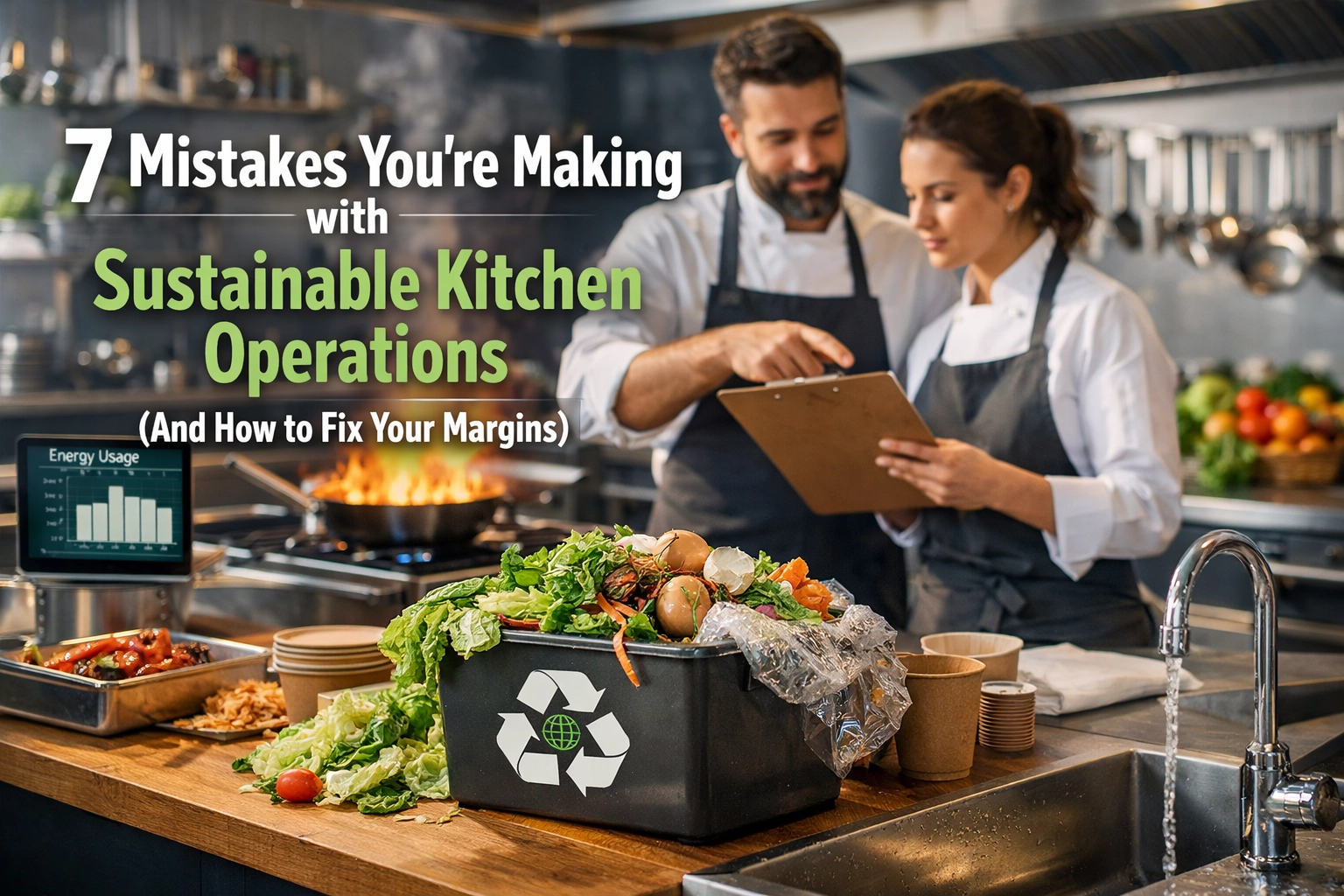
Let’s be honest for a second: the word "sustainability" usually gets a bad rap in the back of the house. To most grizzled kitchen managers and exhausted owners, it sounds like an expensive hobby for people who have too much free time and not enough food cost concerns. You hear "green" and you think "expensive," "labor-intensive," or "another thing for the health inspector to look at."
But here’s the reality that the most successful operators, the ones scaling from one unit to ten, already know: Sustainability isn't about saving the whales (though that’s a nice perk). It’s about saving your margins.
At Restaurant Revenue Incubator, we look at everything through the lens of the Triple Bottom Line: People, Planet, and Profit. If a "green" initiative doesn't eventually lead to more green in your bank account, you’re doing it wrong. In a world where labor costs are skyrocketing and ingredient prices are more volatile than a line cook on a Friday night, your kitchen's efficiency is your only shield.
Are you making these seven common mistakes? Let’s find out, and more importantly, let’s talk about how to fix them with zero upfront cost.
1. The "Set It and Forget It" Staff Training
You bought the recycling bins. You put up the "Turn Off the Lights" stickers. You even bought the expensive compostable straws. Then, two weeks later, you find a gallon of heavy cream in the trash and the walk-in door propped open with a crate of lettuce.
The Mistake: Treating sustainability as a one-time announcement rather than a core operational culture. Without proper, ongoing training, even the best-intentioned initiatives fall flat.
The Fix: You need to gamify efficiency. Data shows that mid-sized restaurant chains that implement specific green kitchen training can see a 25% reduction in food waste. That’s not just "feel-good" stuff; that’s thousands of dollars back on your P&L. Train your staff to understand that a wasted tomato isn't just a tomato, it’s the labor that prepped it, the energy that kept it cold, and the profit margin of the salad it was supposed to go in.
2. The Missing Waste Management Gold Mine
If you’re just throwing everything into one big dumpster behind the building, you’re literally throwing money away. Most operators view waste as an inevitable cost of doing business. It’s not.
The Mistake: Lacking a comprehensive waste reduction strategy. If you don't have smart storage solutions or a clear composting protocol, you’re paying for hauling fees on weight that shouldn't be there.

The Fix: Integrate composting stations and smarter inventory rotation. Modern smart storage solutions can extend the shelf life of your high-cost proteins and produce by days. Every day of shelf life added is a direct boost to your bottom line. If you’re looking to refresh your brand’s image to match these new high-standard operations, consider checking out our Restaurant Websites & Brand Design services to tell your sustainability story to your customers.
3. Clinging to "Fossilized" Equipment
I get it. That 15-year-old reach-in is still humming (well, more like grinding), and you don't want to drop $5,000 on a new one. But that old beast is likely sucking energy like a vacuum and leaking refrigerant.
The Mistake: Thinking that "if it ain't broke, don't fix it" applies to energy-intensive appliances.
The Fix: Upgrading to ENERGY STAR-rated equipment, dishwashers, refrigerators, and ovens, can conserve up to 10% of both water and energy. In a high-volume environment, those utility savings pay for the equipment faster than you think. And remember, at Restaurant Revenue Incubator, we specialize in "No Upfront Cost" turnarounds. We help you find the hidden leaks in your budget so the equipment literally pays for itself.
4. Flying Blind Without Performance Monitoring
How much water did your kitchen use last Tuesday? How many kilowatt-hours did your HVAC pull during the lunch rush? If you don’t know, you’re just guessing.
The Mistake: Failing to track energy and water consumption. You cannot manage what you do not measure.

The Fix: Install sub-metering or use smart utility tracking software. When you see a spike in water usage at 2:00 AM, you know you have a leak. When you see energy usage stay high after closing, you know the night crew is leaving the burners on. This data-driven approach turns your utility bill from a "surprise" into a controllable variable.
5. Treating Water Like It’s Infinite
Water is often the most overlooked utility in the kitchen. Between the dish pit, the prep sinks, and the constant floor mopping, the gallons add up, and so does the bill for the water and the energy used to heat it.
The Mistake: Neglecting water conservation technologies like greywater recycling or low-flow valves.
The Fix: Simple switches, like high-efficiency pre-rinse spray valves, can save hundreds of dollars a year with almost zero effort. For larger operations, implementing systems that reuse greywater for secondary purposes (like cleaning floors or sidewalks) can drastically reduce your environmental footprint and your monthly overhead.
6. Ignoring the "Smart" in Smart Kitchens
We live in the age of AI and automation, yet many kitchens are still run like it’s 1995. If your fans are running at 100% when there’s nothing on the stove, you’re burning cash.
The Mistake: Not integrating smart kitchen systems or automation.

The Fix: Demand-controlled ventilation systems can sense heat and smoke, ramping up the fans only when necessary. Smart sensors can alert you if a walk-in temperature dips before the food spoils. Leveraging tech isn’t just about being "high-tech"; it’s about being high-margin. If you’re curious about how to kit out your staff as you modernize, you can find our branded gear, from hats to hoodies, over at our shop.
7. The Lack of Employee Engagement (The "Green Team" Gap)
Top-down mandates rarely work in a restaurant. If the owner says "we're recycling now" but the dishwasher doesn't understand why, the blue bin will be full of chicken bones by 6:00 PM.
The Mistake: Failing to create a "Green Team" or giving staff ownership over sustainability goals.
The Fix: Find the employees who actually care about this stuff, and there are always a few. Empower them to lead the initiative. When the staff feels like they are part of a mission, saving the planet while saving the restaurant, morale goes up. High morale leads to lower turnover. Lower turnover leads to lower training costs. That is the "People" part of the Triple Bottom Line in action.

The Bottom Line: Profitability is Sustainable
At the end of the day, sustainability in a kitchen isn't a moral crusade; it's an operational discipline. It’s the difference between a 3% margin and a 10% margin.
Most restaurant owners are too busy fighting fires to look at their utility bills or audit their trash cans. That’s where we come in. At Restaurant Revenue Incubator, we don't just give you a list of things to do. We partner with you to implement these changes.
Our "No Upfront Cost" turnaround services mean we look for the inefficiencies, the wasted energy, the thrown-away food, the bloated tech stacks, and fix them. We get paid when you save money. It’s the ultimate win-win.
Scaling a restaurant concept requires a rock-solid foundation. You can’t build a skyscraper on a swamp, and you can’t scale a restaurant that’s bleeding cash through its kitchen vents.
Ready to stop making these mistakes?
Stop letting your profits leak out of your back door. Let's look at your operations through a data-driven lens and turn your kitchen into a high-efficiency, sustainable profit machine.
Check out our full site to learn more about our philosophy, or dive into our category archives for more deep dives into leadership and tech.
Your margins will thank you. Your staff will thank you. And yeah, the planet will probably be pretty happy about it, too.