Restaurant Technology · Uncategorized
The Proven Restaurant Growth Framework: Scale From 1 to 5 Locations in 18 Months Using AI, Sustainability, and Zero Upfront Capital
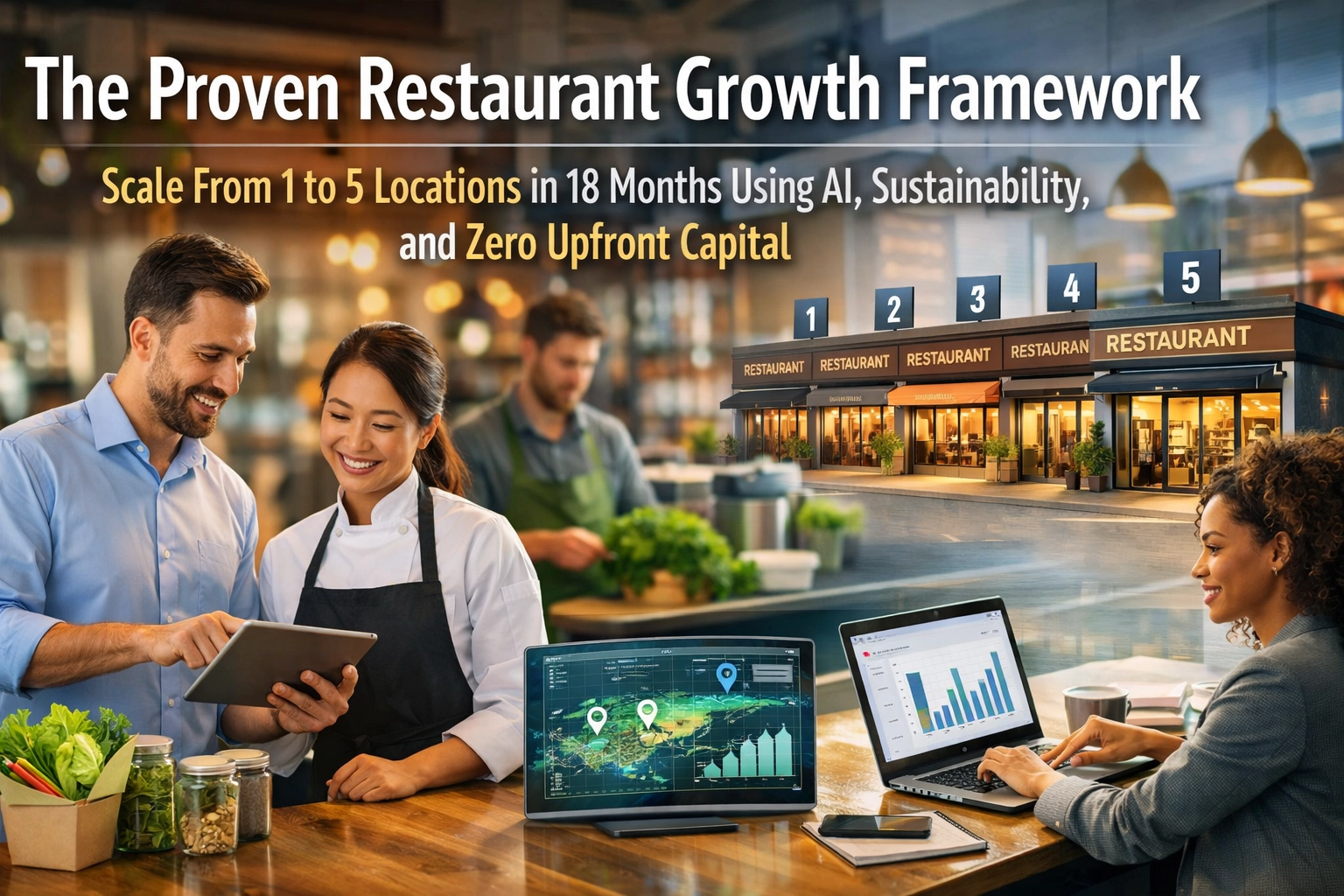
Let's get real for a second: the restaurant industry is celebrating $1.55 trillion in sales for 2026, but when you strip away the price hikes and inflation, real growth is sitting at a pathetic 1.3%. Even worse? Only 42% of restaurant operators reported being profitable last year.
If you're running a single successful location and dreaming about expansion, you're not just competing for new customers: you're fighting for survival in a market where half your peers are underwater.
Here's the good news: the old playbook is dead, but a new one exists. And it doesn't require you to drain your savings, take out predatory loans, or risk everything on a gut feeling. The modern restaurant growth framework leverages three critical pillars: AI-driven operations, sustainability as a profit center, and zero upfront capital: to scale from one location to five in 18 months.
Sound too good to be true? Let's break it down.
Why Traditional Growth Models Are Broken (And Expensive)
The traditional path to multi-unit restaurant ownership looks something like this: nail your first location, save up capital, secure a loan, find real estate, replicate your systems, hire new managers, and pray the next location performs like the first one.
The problem? Every step of that process is expensive, slow, and risky. You're betting hundreds of thousands of dollars that your concept will work in a new market, with a new team, under different operating conditions. And if location two underperforms? You're stuck servicing debt on a failing unit while your flagship location suffers from split attention.

But here's what changed in 2026: technology, consumer expectations, and capital structures have evolved faster than most operators realize. The same AI tools that were "luxury tech" three years ago are now operational necessities. The same sustainability practices that were "nice to have" are now cost-saving requirements. And the same turnaround firms that used to charge six-figure retainers are now offering performance-based models with zero upfront cost.
Welcome to the new era of restaurant growth.
The Three-Pillar Framework for Rapid Scaling
Pillar 1: AI-Driven Operational Excellence
Let's start with the most misunderstood piece of the puzzle: artificial intelligence. When most restaurant owners hear "AI," they think of kiosks and robots flipping burgers. That's not what we're talking about.
The AI revolution in restaurants is happening in the back office, not the front of house. According to recent industry data, 60% of restaurant executives now identify enhanced customer experience as the primary benefit of AI implementation: but the real magic happens in three less sexy areas:
Inventory Management: AI-driven demand forecasting reduces food waste by analyzing sales patterns, weather data, local events, and even social media trends. For a restaurant doing $2 million in annual revenue, cutting food waste from 8% to 4% means an instant $80,000 back in your pocket. Scale that across five locations and you're looking at $400,000 in recovered margin.
Labor Optimization: AI scheduling tools don't just create rosters: they predict demand spikes, identify overstaffing patterns, and optimize shift coverage to the 15-minute increment. The best operators are seeing 2-3% labor cost reductions without cutting service quality.
Menu Engineering: This is where AI gets really interesting. By analyzing sales velocity, contribution margin, and ingredient overlap across your menu, AI can recommend dish eliminations, portion adjustments, and strategic price increases that customers won't even notice. One of our clients removed 12% of their menu items and saw a 7% increase in profitability because kitchen efficiency skyrocketed.

Here's the kicker: these AI tools are now available as subscription services for $500-$2,000 per month. Five years ago, this level of analytics required a $50,000 consulting engagement. Now it's plug-and-play.
Pillar 2: Sustainability as a Profit Driver (Not a Cost Center)
Let's talk about the elephant in the room: sustainability. Most restaurant operators hear "green initiatives" and immediately think it's a buzzword for expensive equipment and virtue signaling. Wrong.
The triple bottom line approach: measuring success through People, Planet, and Profit: isn't just good ethics. It's good business. Here's why:
Energy Efficiency = Immediate ROI: LED lighting retrofits pay for themselves in 18-24 months. Energy-efficient HVAC systems cut utility costs by 20-30%. Smart thermostats and automated lighting controls save another 10-15%. For a typical restaurant spending $4,000/month on utilities, that's $800-$1,200 back in your pocket every single month. Scale that across five locations and you're looking at $50,000+ in annual savings.
Waste Reduction = Margin Protection: Remember that AI inventory system we talked about? It's not just reducing waste: it's aligning with the sustainability practices that Millennial and Gen Z diners actually care about. Restaurants that promote their waste reduction efforts see a 15-20% increase in loyalty program sign-ups among younger demographics.
Sustainable Sourcing = Marketing Gold: Here's the secret: "locally sourced" and "seasonal ingredients" aren't just marketing buzzwords: they're margin protectors. When you build relationships with local farms and suppliers, you cut transportation costs, reduce spoilage from long supply chains, and gain pricing flexibility that commodity-driven menus can't match.

The best part? Every dollar you save through sustainability initiatives is a dollar that doesn't show up on your P&L as a cost cut. You're not reducing portions or firing staff: you're optimizing systems. And in 2026, with only 42% of operators profitable, that distinction matters.
Pillar 3: The Zero Upfront Capital Model
Here's where the framework gets really interesting. Traditional expansion requires massive capital outlays: real estate deposits, equipment purchases, build-out costs, pre-opening expenses. You're looking at $500,000 to $1.5 million per location before you serve your first plate.
But what if you could flip that model entirely?
The new generation of restaurant turnaround firms (like Restaurant Revenue Incubator) are offering performance-based partnerships with zero upfront capital. Here's how it works:
-
Diagnostic Phase (30 Days): We audit your existing location's P&L, operations, tech stack, and growth potential at no cost.
-
Optimization Phase (90 Days): We implement AI tools, sustainability practices, and operational improvements at your flagship location. You pay nothing upfront: compensation comes from a percentage of the savings we generate.
-
Replication Phase (120 Days): Once your first location is operating at peak efficiency with documented playbooks, we help you identify and open location two using the proven systems.
-
Scaling Phase (Months 6-18): With two locations humming and cash flow improving, locations 3-5 follow the same playbook at 90-120 day intervals.
The beauty of this model? You're not betting your savings on a dream. You're scaling with operational proof, documented systems, and financial performance that's already been stress-tested.
The 18-Month Timeline (Month by Month)
Months 1-4: Optimize location one. Implement AI inventory, sustainability initiatives, and margin improvements. Goal: Increase profitability from 5-8% to 12-15%.
Months 5-7: Open location two using proven systems, trained staff, and documented playbooks. Goal: Break-even by month three of operation.
Months 8-10: Stabilize location two while scouting location three. Refine central operations and supply chain efficiencies.
Months 11-13: Open location three. Goal: Profitability within 60 days due to refined systems.
Months 14-16: Open location four. At this point, your central operations team and supply chain efficiencies create significant advantages.
Months 17-18: Open location five. Your brand now has regional presence, negotiating power with suppliers, and operational scale that single-unit competitors can't match.

Is it aggressive? Absolutely. Is it possible? With the right systems, technology, and capital structure, we're seeing it happen in real-time.
The Market Share War of 2026
Remember that 1.3% real growth number we started with? Here's what it means: if you want to grow in 2026, you can't wait for "new customers" to magically appear. You have to take them from your competitors.
That means your brand needs to be sharper, your operations need to be tighter, and your value proposition needs to be undeniable. The restaurants winning in this environment aren't the ones with the flashiest concepts: they're the ones with bulletproof operations, sustainable cost structures, and the ability to deliver consistent experiences across multiple locations.
AI gives you the data. Sustainability gives you the margins. Zero upfront capital gives you the runway. The framework gives you the roadmap.
Your Next Move
If you're running a single location that's profitable but plateaued, or if you've been dreaming about expansion but can't stomach the traditional risk profile, this framework is designed for you.
The 42% of restaurant operators who are profitable in 2026 aren't smarter than you: they just have better systems. And the operators who will dominate the next five years are the ones willing to embrace AI, sustainability, and modern capital structures right now.
Want to see if your concept is ready to scale? We'll audit your P&L for free and show you exactly where the opportunities are hiding. No upfront cost. No obligation. Just data, systems, and a roadmap to five locations.
Because in a market growing at 1.3%, sitting still is the same as going backwards. And going backwards isn't an option anymore.
Ready to scale? Visit Restaurant Revenue Incubator to schedule your free diagnostic review.