Restaurant Technology · Uncategorized
Eco-Friendly Restaurant Profit: 10 Sustainable Kitchen Operations That Pay for Themselves in 90 Days
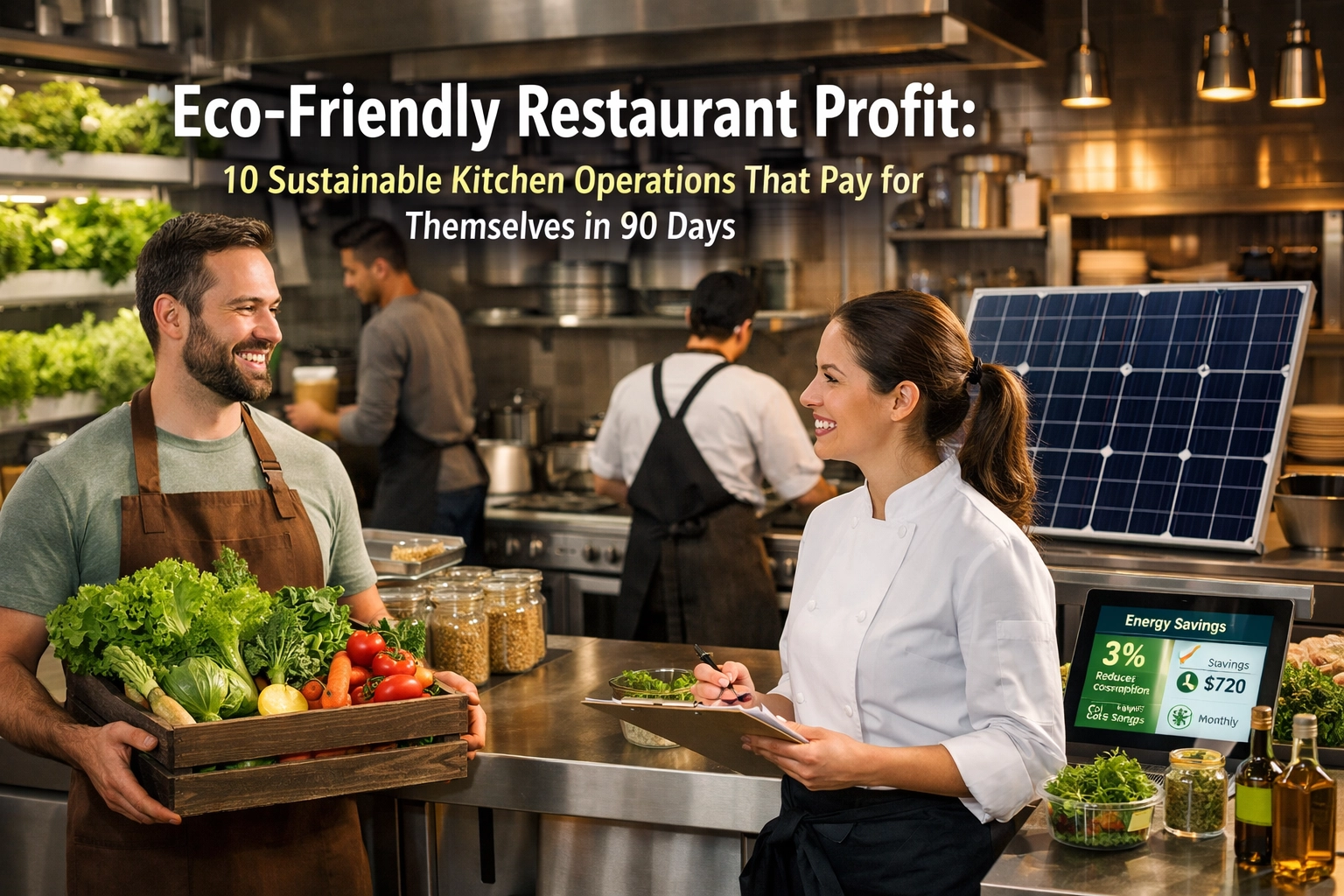
Let's kill the myth right now: "going green" doesn't mean bleeding red on your P&L.
In fact, the restaurants crushing it in 2026 have figured out something Wall Street learned decades ago: sustainability isn't a cost center, it's a profit engine. The triple bottom line (People, Planet, Profit) isn't some feel-good MBA buzzword anymore. It's how you stay competitive when labor costs are at $20/hour and food inflation refuses to quit.
Here's the deal: most operators think "eco-friendly" means expensive solar panels, compostable everything, and a menu that tastes like cardboard. Wrong. The best sustainable operations are the ones that cut costs faster than they cut carbon.
We're talking 90-day payback periods. Real money. Let's break down the 10 moves that'll put cash back in your pocket while making Mother Nature slightly less angry at you.
1. LED Lighting: The No-Brainer $200/Month Savings
If your kitchen still has those old halogen or incandescent bulbs, you're literally burning money. LED bulbs use 75% less energy and last 25 times longer.
The Math: A typical 3,000-square-foot restaurant spends about $300/month on lighting. Switching to LEDs drops that to $100/month. Installation cost? Around $1,500-$2,000 for a full retrofit. Payback period: 7-10 months. But the real kicker? LEDs produce way less heat, which means your AC doesn't have to work as hard. That's another $50-$100/month in your pocket.
Pro tip: Many utility companies offer rebates for LED upgrades. Check with your local provider: you might cut that upfront cost in half.

2. Energy-Efficient Appliances: The 20-30% Energy Hack
Old equipment is an energy vampire. ENERGY STAR-certified appliances can reduce energy consumption by 20-30%, and with commercial kitchens accounting for nearly 60% of a restaurant's total energy use, that's not chump change.
Take the Electrolux Professional SkyLine Combi Oven: it uses AI to optimize cooking cycles and has automated cleaning systems that slash water usage. Real-world results? Up to 20% savings on energy costs and faster cook times that increase kitchen throughput.
The Math: If you're spending $2,000/month on kitchen energy, a 25% reduction saves you $500/month. A high-efficiency combi oven might run you $8,000-$12,000, but with utility rebates and the monthly savings, you're looking at payback in 18-24 months. Not quite 90 days, but the compounding savings over 10+ years make this a no-brainer.
3. Smart HVAC Controls: Set It and Forget It (While Saving $300/Month)
Your HVAC system doesn't need to blast at full power when the kitchen is closed or during slow periods. Smart thermostats and zone controls adjust heating and cooling based on real-time demand.
The Math: Restaurants waste about 30% of their HVAC energy during off-peak hours. A smart system costs $1,500-$3,000 to install and can save $200-$400/month. Payback: 5-10 months.
Bonus? Your staff stops fighting over the thermostat.
4. Water-Saving Pre-Rinse Spray Valves: $1,000/Year for $150
This one's almost offensive in how simple it is. Old spray valves use 3-5 gallons per minute. Modern low-flow valves use 1.28 gallons per minute and actually clean better because of improved pressure design.
The Math: If you're running that spray valve 3 hours a day, you're wasting about 50,000 gallons per year. At typical water/sewer rates, that's $800-$1,200 annually. A new valve costs $100-$200. Payback: 1-2 months. Seriously. Do this today.

5. Local & Seasonal Sourcing: Cut Food Costs by 15-20%
Here's where sustainability meets straight-up smart procurement. Seasonal produce is cheaper because it's abundant. Local sourcing eliminates fuel surcharges and reduces spoilage from long transit times.
The Math: A farm-to-table concept in Portland saved 18% on produce costs by switching to a local co-op and building menus around what's in season. If you're spending $15,000/month on food, that's $2,700/month back in your pocket. Payback: Immediate.
Plus, "locally sourced" is a marketing goldmine. Customers will pay a premium for it, and your food cost percentage stays healthy.
6. Food Waste Tracking: Stop Throwing Away $2,000/Month
The average restaurant tosses 4-10% of its food purchases straight into the trash. That's pre-consumer waste (prep mistakes, over-ordering) and post-consumer waste (uneaten portions).
The Fix: Implement a simple waste tracking system. Weigh what you're throwing out for two weeks, categorize it, and adjust. Apps like Leanpath or even a basic spreadsheet work.
The Math: If you're buying $20,000/month in food and wasting 7%, that's $1,400/month in the dumpster. Cut that in half through better portioning and smarter ordering? You just found $700/month. Payback: Instant.
7. Composting Programs: Turn Trash Into Cash (or at Least Savings)
Food waste in landfills generates methane, which is bad. But here's the business case: composting can cut your waste hauling costs by 30-50% because you're diverting a massive chunk of your trash volume.
The Math: If you're paying $600/month for waste removal, a composting program (including bin rentals and pickup) might cost $300/month while reducing your regular trash service to $250/month. Net savings: $50/month, plus potential tax credits in some municipalities. Payback: 6-12 months.
Some progressive cities even offer compost pickup for free. Do your homework.

8. Reusable & Sustainable Packaging: The To-Go Goldmine
Single-use plastics are getting banned left and right. But sustainable packaging doesn't have to cost more: in fact, switching to reusable containers for catering or dine-in can actually increase margins.
The Play: Offer a small discount (5%) to customers who bring reusable containers for takeout, or use compostable packaging that costs 10-20% more but can be marketed as premium. Studies show 67% of diners will pay more for sustainable packaging.
The Math: If 20% of your takeout customers opt for reusables and you save $0.50 per order, that's $300-$500/month on a busy operation. Upfront cost to buy quality reusable containers? $500-$1,000. Payback: 2-3 months.
9. Plant-Based Menu Expansion: Lower Food Costs, Higher Margins
Meat is expensive. Beans, lentils, and vegetables? Not so much. A plant-based burger costs about $1.20 to make. A beef burger costs $2.80. Both sell for $12-$14.
The Math: If you sell 100 plant-based entrees per week at a $1.60 higher margin, that's $640/month in pure profit. Menu R&D and marketing might cost $2,000 upfront. Payback: 3-4 months.
And before you say "but my customers won't order it": plant-based sales grew 27% in 2025. The market is begging for this.
10. Smart Kitchen Management Systems: Automate Everything
This is the big one. Platforms that integrate your POS, inventory, energy usage, and prep schedules can optimize your entire operation in real time. They adjust refrigeration based on door-open frequency, predict ingredient needs to minimize spoilage, and auto-schedule equipment maintenance.
The Math: A smart kitchen system costs $5,000-$10,000 to implement but can reduce energy costs by 15%, cut food waste by 20%, and improve labor efficiency by 10%. For a $100,000/month operation, that's $3,000-$5,000/month in combined savings. Payback: 2-3 months.

The Triple Bottom Line Reality Check
Here's what the best operators understand: People, Planet, Profit aren't separate goals: they're connected.
When you cut energy waste, you're reducing your carbon footprint and lowering your operating costs. When you source locally, you're supporting your community and improving your margins. When you reduce food waste, you're feeding more people and keeping money in your business.
The restaurants that win in 2026 and beyond aren't choosing between profitability and sustainability. They're using sustainability as their profitability strategy.
Our Take: No Upfront Cost Means No Excuses
At Restaurant Revenue Incubator, we've helped dozens of operators implement these exact systems with zero upfront cost. Our model is simple: we fund the upgrades, you pay us back from the savings. If it doesn't work, you don't pay.
Why? Because we've seen the numbers. These systems work. And if you're still hesitating because you think "going green" is too expensive or too complicated, you're leaving money on the table while your competition scoops it up.
The planet doesn't need you to be a martyr. It needs you to be profitable enough to stick around. These 10 operations aren't about saving the world: they're about saving your business. The fact that they happen to be good for the environment? That's just a bonus.
Ready to see how sustainable operations can transform your P&L? Let's talk. Visit Restaurant Revenue Incubator and let's build your 90-day turnaround plan: no upfront cost, no BS, just results.