Restaurant Technology · Uncategorized
The $1.55 Trillion Question: How Smart Operators Are Scaling Restaurant Concepts in 2026
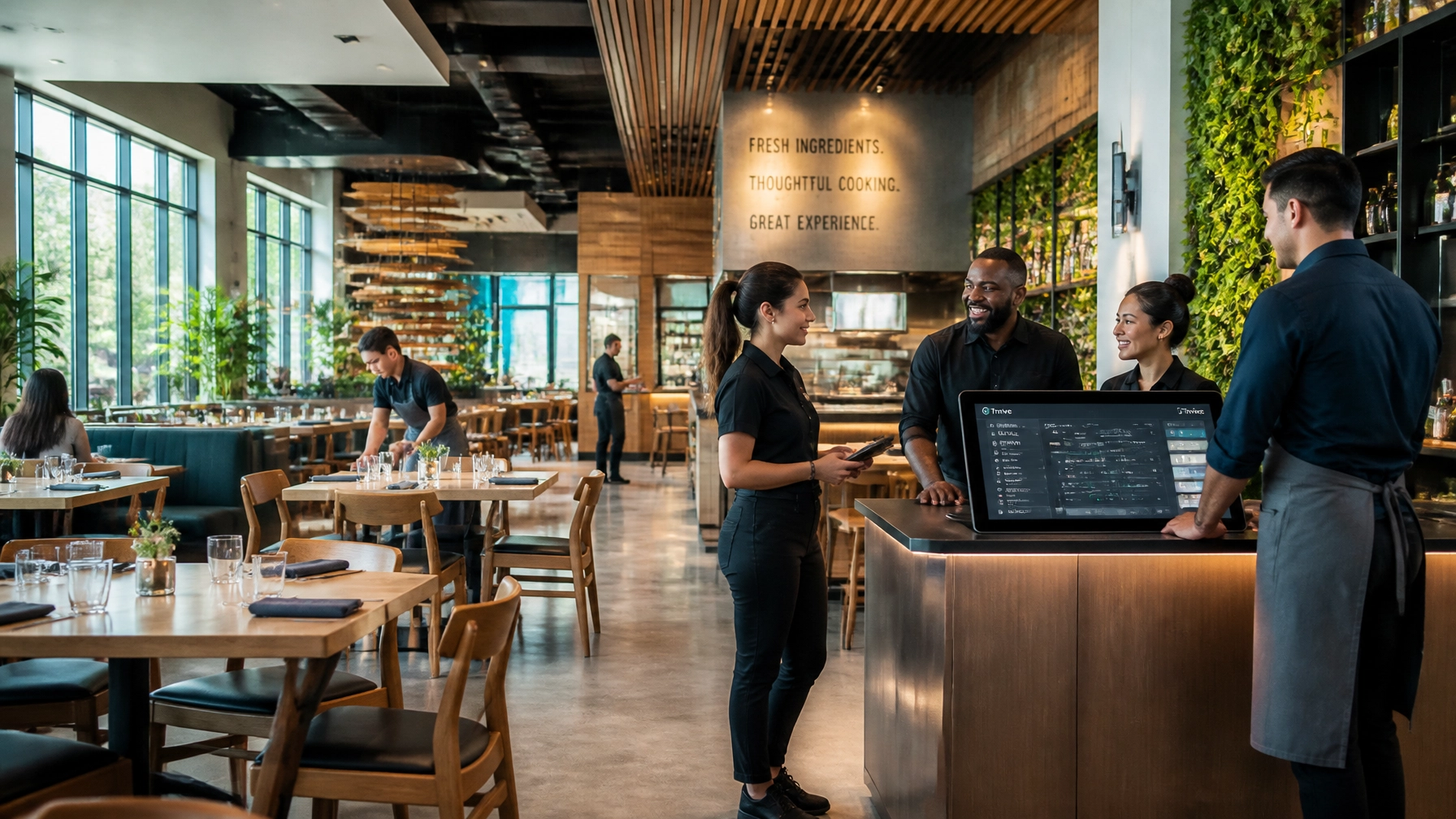
As we cross the midpoint of 2026, the American restaurant industry has hit a staggering milestone: a projected $1.55 trillion in annual sales. It’s a number so large it sounds like a typo, but for the modern operator, the reality on the ground is a bit more nuanced. While nominal growth is soaring, real (inflation-adjusted) growth is holding steady at about 1.3%.
In this environment, the "gold rush" mentality of opening locations as fast as humanly possible has been replaced by a more surgical approach. Today, scaling isn't just about adding doors; it’s about building a sustainable, high-output engine that can weather economic shifts. If you’re asking how to capture your slice of that $1.55 trillion pie, you’ve come to the right place.
The Shift from Speed to Sustainability
The most telling statistic of 2026 isn't the total sales: it’s the fact that 57% of operators are not planning new locations in the second half of the year. Why? Because the industry has collectively realized that a "growth at all costs" strategy often leads to "costs at all growth."
Instead, the focus has shifted toward eco-friendly restaurant profit models that emphasize the Triple Bottom Line: People, Planet, and Profit. Smart operators are discovering that reducing food waste and optimizing energy usage isn’t just a PR win: it’s a margin-saving necessity. When you save 15% on utilities through smarter kitchen management, that money goes straight back into your expansion fund.
The Franchise Landscape: Quality Over Legacy
Despite the cautious outlook on new units for some, the International Franchise Association (IFA) still projects over 12,000 new franchise openings this year, bringing the total establishment count to 845,000. However, where that growth is happening has changed.
We are seeing a massive "franchisee flight" toward newer, high-growth brands. Concepts like Dutch Bros, Dave’s Hot Chicken, and Raising Cane’s are capturing the market share that legacy underperformers are losing. Multi-unit operators are also consolidating their power; the average franchisee now owns roughly 4.2 units, a significant jump from the 2.8 units we saw a decade ago.
Scaling restaurant concepts in this landscape requires more than just a famous name; it requires a "scale-ready" operational model.

Is Your Concept "Scale-Ready"?
Before you even think about restaurant expansion funding, you must ensure your unit economics are bulletproof. At Restaurant Revenue Incubator, we define a "scale-ready" concept by three core pillars:
- Productivity Stability: Can your team handle a 20% surge in volume without the wheels falling off?
- Contribution Margin Cushion: Do you have enough breathing room to absorb a 5% spike in protein costs?
- Liquidity Visibility: Do you know exactly where your cash is tied up at any given second?
If the answer to any of these is "I think so," you might need restaurant operations support to tighten the ship. Most "failed" expansions don't fail because the food was bad; they fail because the backend was held together by duct tape and hope.
The FSR Renaissance and Regional Hotspots
For the first time since the pandemic, Full-Service Restaurants (FSR) are outpacing Quick-Service Restaurants (QSR) in output growth. In 2026, consumers are craving experiential dining. They don't just want a meal; they want a story, a vibe, and a reason to leave their couch.
Geographically, the map is glowing red in the Southeast and Southwest. These regions are leading the charge with 1.7% and 2.5% growth rates, respectively. If you’re looking for a new site, following the sun (and the favorable tax climates) is a statistically sound restaurant growth strategy.
Tech Stack Optimization: The AI Revolution
If your "tech stack" is just a POS system and a prayer, you’re already behind. By mid-2026, AI adoption for back-office reporting has skyrocketed from 25% to 69%.
Operators aren't just using AI to write clever Instagram captions; they’re using it for predictive inventory and food cost reduction. In fact, 61% of AI users report lower food costs because the machine is better at predicting that you'll need 14% more cilantro on a rainy Tuesday than your manager is.

Restaurant tech stack optimization is no longer optional. It’s the difference between a 3% margin and a 10% margin. By leveraging data-driven site selection and loyalty ecosystems, operators can finally stop guessing and start growing.
Local Events and the "Hyper-Local" Strategy
In a world of global brands, the winners in 2026 are those who act local. Over 51% of successful operators have integrated local events and catering into their core growth strategy. Whether it’s a pop-up at a neighborhood festival or a robust corporate catering program, these high-margin revenue streams provide the cash flow needed to fund the next location.

Funding Without the Headache
Perhaps the biggest hurdle to scaling is the capital itself. Traditionally, you had two choices: take a high-interest loan that eats your soul or give away a massive chunk of your equity to a shark-like investor.
We think that’s a terrible deal. That’s why we offer alternative restaurant expansion funding through our partners. Imagine getting the capital you need to scale in exchange for food & beverage credits.
- No Interest.
- No Equity.
- No Dilution.
You get to keep your company, and we help you fill your tables. It’s the closest thing to a "free lunch" in the financial world: except you’re the one providing the lunch (and getting paid to scale).
The 2-Week Turnaround: Risk-Free Growth
Sometimes, the obstacle to growth isn't a lack of locations, but a lack of efficiency in the ones you already have. This is where our restaurant turnaround services come in.
We are so confident in our 50+ years of combined experience that we offer a no-upfront-cost turnaround framework. We review your tech stacks, P&Ls, and operations for free. If we can’t find ways to improve your business and deliver insights from day one, you don't owe us a dime. We only ask for a share of the results we create. It’s a risk-free approach that ensures our goals are perfectly aligned with yours.
The Planet-Profit Connection
Finally, we can't talk about 2026 without talking about sustainability. As part of our commitment to the Triple Bottom Line, we help restaurants implement cost-saving eco-friendly practices. From energy-efficient equipment to waste reduction systems, these "green" initiatives are often the secret weapon of high-profit groups.

In 2026, being a "good" business owner means being good to your people, good to the planet, and very good at making a profit.
Scale Smarter, Not Just Faster
The $1.55 trillion opportunity is real, but it belongs to the disciplined. By focusing on "scale-ready" unit economics, optimizing your tech stack, and utilizing creative funding models, you can grow your concept into a powerhouse brand without losing your mind: or your equity.
Ready to see what a professional growth partner can do for your restaurant? Let’s look at your P&L and find the hidden profit together.
[Contact Restaurant Revenue Incubator Today for Your Free Strategy Review]