Restaurant Technology · Uncategorized
Sustainable Kitchen Operations That Actually Make Money: 7 Tech Fixes Under $500/Month
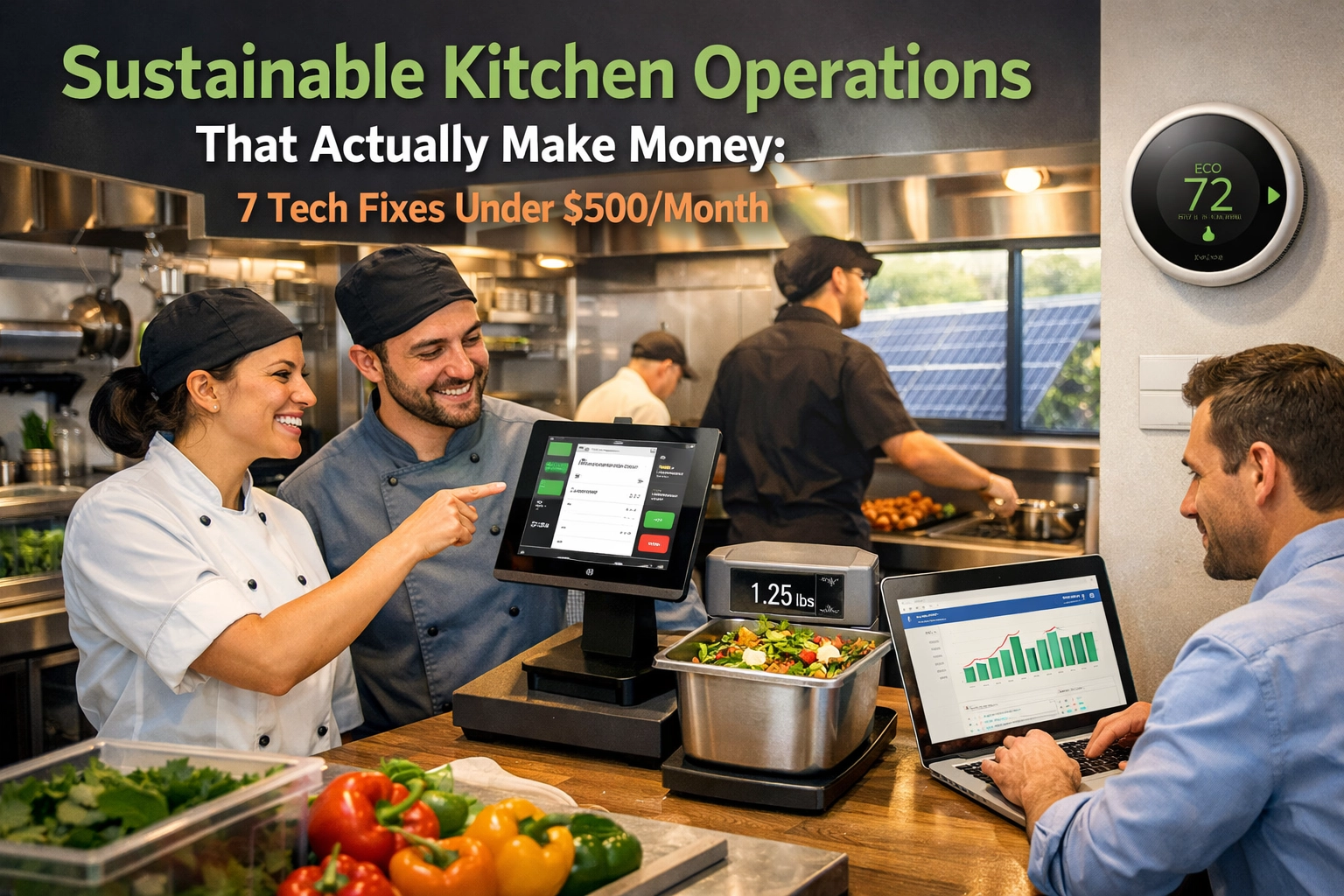
Let's talk about the elephant in the walk-in: sustainability still sounds expensive to most restaurant operators. You hear "green initiatives" and immediately picture solar panels, a five-figure investment, and a 10-year payback period that makes you want to cry into your compost bin.
Here's the reality nobody's talking about, the most profitable sustainability moves in 2026 cost less than your monthly linen service. We're talking tech solutions under $500 per month that start saving you money in week one. No venture capital required. No waiting for tax credits. Just immediate cost reduction that actually shows up on your P&L.
The triple bottom line isn't just consultant-speak anymore. It's People (your team and customers), Planet (the rock we all live on), and Profit (the thing that keeps your doors open). When these three align? That's when restaurant economics get really interesting.

1. Smart Energy Monitoring: The Reality Check Your Electric Bill Needs
Cost: $99-$299/month
Remember when you had to guess which equipment was killing your energy bill? Those days are gone. Smart energy monitoring systems connect to your electrical panel and tell you exactly which piece of equipment is hemorrhaging money.
The data's brutal but beautiful: most restaurants discover their walk-in coolers are running 40% more than necessary, kitchen hoods stay on during closed hours, and that "energy-efficient" oven from 2010 is actually costing $180/month more than it should.
Systems like Powerley or Sense for commercial kitchens track usage in real-time. You get alerts when equipment runs inefficiently, and the software learns your patterns. One Seattle restaurant group cut their energy costs by 23% in the first 90 days, that's $850/month in savings for a $249/month subscription.
ROI Timeline: 4-8 weeks
2. LED Lighting Retrofit: The Fastest Money You'll Ever Make
Cost: $150-$350/month (financed install)
This one's almost embarrassing to include because it's so obvious, but most restaurants are still burning money with outdated lighting. Not the dining room, you already fixed that, we're talking about BOH.
Commercial-grade LED fixtures use 75% less energy than traditional bulbs and last 25 times longer. For a typical 2,500 square foot kitchen, you're looking at $200-$400/month in electricity savings alone. Then factor in labor costs, when's the last time your kitchen manager spent an hour changing bulbs on a stepladder?
Many utility companies offer rebates that cover 30-50% of installation costs. Some lighting companies finance the whole project based on your energy savings, meaning you literally pay nothing upfront and still net positive cash flow month one.
ROI Timeline: Immediate (with rebates)

3. Food Waste Tracking Software: Where Guilt Meets Gross Margin
Cost: $200-$450/month
Food waste is the silent profit killer. The average restaurant throws away 4-10% of food purchased. For a restaurant doing $150K/month in revenue, that's $6,000-$15,000 going straight into the dumpster.
Platforms like Winnow or Leanpath use AI-powered scales and cameras to track exactly what you're tossing. Prep scraps? Overproduction? Spoilage? The system categorizes everything and shows you patterns you'd never spot manually.
One Chicago steakhouse discovered they were over-prepping Caesar salad by 30% every Friday. That single insight saved them $780/month. A fast-casual chain realized their portioning was inconsistent across locations, fixing that standardization saved 7% on protein costs across the board.
The psychological impact is real too. When your line cooks see a screen showing "$47 wasted today," behavior changes fast. Waste tracking has an immediate cultural effect that extends beyond the software itself.
ROI Timeline: 3-6 weeks
4. Smart HVAC Controls: Because Your AC Doesn't Need to Run at 2 AM
Cost: $180-$400/month
Your HVAC system is running right now. Want to bet it's working harder than it needs to? Smart thermostats for commercial kitchens (like Nest or Ecobee commercial solutions) learn your traffic patterns and adjust automatically.
They pre-cool spaces before service, reduce output during slow periods, and communicate with your POS system to anticipate rushes. Some systems integrate with kitchen equipment, when you fire up six burners, the hood ventilation adjusts automatically instead of running full-blast 24/7.
The numbers are staggering: ENERGY STAR data shows smart HVAC controls reduce energy consumption by 20-30% in commercial kitchens. For a restaurant spending $2,000/month on climate control, that's $400-$600 in monthly savings.
Plus, you can control everything from your phone. Closing early due to a snowstorm? Adjust the temperature from your couch instead of driving in.
ROI Timeline: 8-12 weeks

5. Water Monitoring and Low-Flow Fixtures: The Leak You Can't See Is Costing You
Cost: $120-$280/month
Water costs are sneaky. They're not as dramatic as electricity, so they slide under the radar. But between dishwashing, ice machines, cooking, and restrooms, restaurants use 5,400 gallons per day on average. That adds up.
Water monitoring systems (like Phyn or Flume commercial) detect leaks in real-time. One dripping pre-rinse spray valve wastes 20 gallons per day, doesn't sound like much until you realize that's $500-$800 annually just from one valve.
Low-flow pre-rinse spray valves are now required in many jurisdictions anyway, but upgraded fixtures across your operation typically save 20-40% on water usage. Many water districts offer free fixtures or rebates, yes, free: because reducing demand helps their infrastructure.
One Austin restaurant group installed monitoring systems across four locations and discovered a toilet leak at a closed location that had been running for six months. That single fix saved $4,200 annually.
ROI Timeline: 4-8 weeks
6. Cloud-Based Inventory Management: Stop Guessing, Start Knowing
Cost: $150-$400/month
Inventory management isn't traditionally considered "sustainable tech," but hear me out: overordering is an environmental and financial disaster. When you order too much produce and it spoils, you've wasted water, transportation fuel, labor, and cold storage energy: plus the actual food cost.
Modern inventory systems (MarketMan, BlueCart, Toast Inventory) integrate with your POS and vendors. They track usage patterns, predict needs based on historical data, and flag anomalies. When your chicken usage spikes 40% in one week, you know immediately: is it theft, waste, or did someone forget to record a catering order?
These systems also optimize ordering schedules. Instead of ordering from five vendors on five different days (requiring five deliveries), the software consolidates orders to reduce delivery frequency. Fewer trucks = lower carbon footprint and often better pricing through volume.
Restaurants using AI-powered inventory systems report 8-15% reduction in food costs within 90 days. For most operations, that dwarfs the subscription cost.
ROI Timeline: 6-10 weeks

7. Automated Refrigeration Monitoring: Sleep Better Knowing Your Coolers Are Actually Cool
Cost: $99-$300/month
Walk-in failures are every operator's nightmare. You arrive at 5 AM to discover the cooler died overnight and you've lost $8,000 in protein. Insurance might cover it, but good luck serving dinner tonight.
Refrigeration monitoring systems (like CoolAutomation or Fridgi) continuously track temperatures and alert you via text the second something goes wrong. Most systems also monitor humidity, door openings, and compressor efficiency.
But here's the money part: these systems optimize compressor cycles to reduce energy consumption. Refrigeration typically accounts for 50% of a restaurant's energy costs. Even a 10% reduction in refrigeration energy is massive.
One Miami restaurant installed monitoring across three locations and discovered two units were cycling inefficiently: not broken enough to fail, but costing an extra $340/month in electricity. The monitoring system paid for itself in three weeks.
Plus, you get compliance documentation for free. Health inspectors love seeing automated temperature logs. No more clipboards and manual checks.
ROI Timeline: 2-4 weeks
The Real Triple Bottom Line Math
Let's add this up conservatively:
- Energy monitoring: $500/month saved
- LED retrofit: $300/month saved
- Food waste tracking: $800/month saved
- Smart HVAC: $400/month saved
- Water monitoring: $150/month saved
- Inventory management: $600/month saved
- Refrigeration monitoring: $250/month saved
Total monthly investment: ~$1,400
Total monthly savings: ~$3,000
Net monthly profit: $1,600
That's $19,200 annually: and we're using conservative numbers. Many restaurants see double these savings.
The People, Planet, Profit Reality
Here's what nobody tells you about sustainable operations: your staff actually cares about this stuff. Gen Z workers (who'll be 30% of the workforce this year) actively choose employers based on environmental values. When you implement visible sustainability tech, retention improves.
The planet benefits are obvious: less waste, less energy, less water. But the profit piece? That's where restaurant operators perk up their ears. These aren't charity projects. They're the highest-ROI investments most restaurants can make.
At Restaurant Revenue Incubator, we implement these exact systems with zero upfront costs. We don't charge until you're already saving money. Why? Because we know the math works.
The question isn't whether you can afford to go green. It's whether you can afford not to. Your competitors are already cutting their utility costs by 25%. Every month you wait is money left on the table.
Want to see what your specific operation could save? Let's run your numbers. No BS, no high-pressure sales: just real data about where your money's going and how to keep more of it.
Reach out to our team and we'll audit your current spend for free. Because sustainable operations aren't about saving the planet (though that's a nice bonus). They're about keeping your restaurant profitable enough to be around for the long haul.
The tech exists. The ROI is proven. The only question is: what are you waiting for?