Restaurant Technology · Uncategorized
Round Two: McDonald’s Is Betting on AI Drive-Thrus Again, and the Data Says the Handoff Is the Whole Game
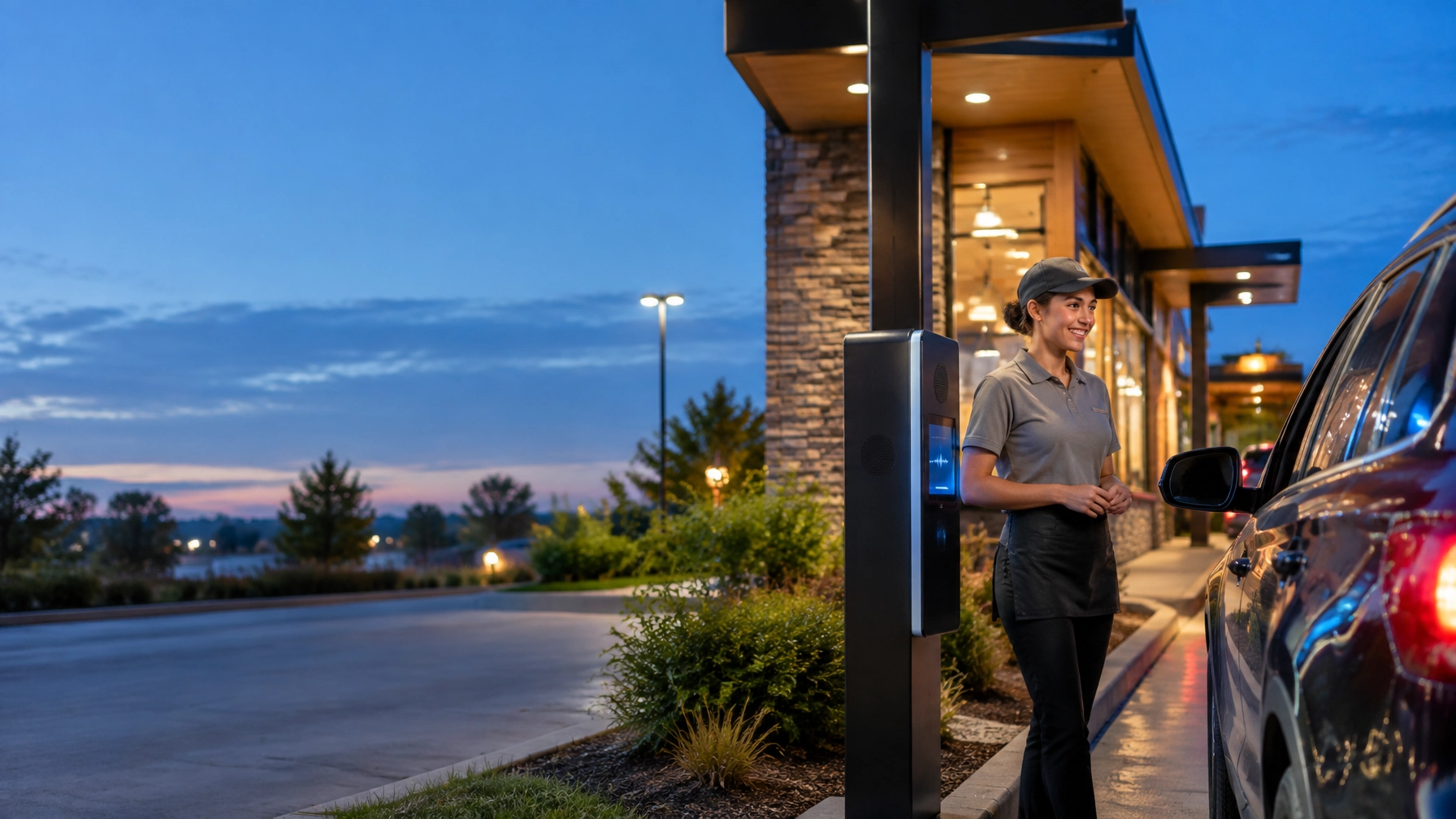
McDonald’s is giving AI drive-thru ordering another turn at bat.
After ending its IBM-powered pilot in 2024 following viral ordering errors, the company has reintroduced voice ordering through ArchIQ, a Google-powered platform featuring an assistant nicknamed “Archy.” The initial test footprint is small, five U.S. restaurants, but a franchisee involved in the rollout reports more than 1 million transactions, with roughly 90% completed without human intervention. ABC News reported on the new test here.
The headline sounds like another chapter in the “man versus machine” debate.
That is the wrong frame.
The real question is: Does the system know when to stop pretending it understands and hand the interaction to a human?
In restaurant AI automation, the handoff rate is not a footnote. It is the whole game.
Why Round One Failed
The first McDonald’s pilot exposed the problem with treating ordering as a simple speech-recognition exercise. Drive-thrus are noisy, customers change their minds, menus contain complicated modifiers, and “no pickles” is not exactly the same as “extra pickles.”
The 2024 system reportedly struggled with background noise, accents, substitutions, and unusual requests. The internet responded with the usual collection of AI bloopers: incorrect quantities, bizarre add-ons, and orders that appeared to gain a mind of their own. McDonald’s eventually ended the test.
That failure was not proof that AI cannot work in restaurants. It was proof that a restaurant cannot outsource judgment without designing a reliable recovery path.
Hospitality also matters. &pizza recently removed both AI voice ordering and kiosks, saying the technology created a disconnect between staff and guests. Meanwhile, reporting from CNN and the Wall Street Journal indicates that McDonald’s, Burger King, Wendy’s, and other major brands are re-emphasizing visible human service alongside automation.
Customers do not necessarily want every interaction automated. They want the friction removed, and a person available when the friction inevitably appears.
Why Round Two Is Different
The more mature approach is human-in-the-loop automation.
AI handles the repetitive, high-volume portion of the transaction. It confirms the order, processes common modifications, and sends clean data into the POS. When confidence falls below an acceptable threshold, the system escalates to a trained employee instead of improvising.
That design is already producing more realistic benchmarks:
- Bojangles and Hi Auto: deployed across nearly 500 locations, with approximately 96% order accuracy and 93% of orders completed without a handoff. Hi Auto’s restaurant technology information is available here.
- White Castle: staff intervention in roughly 5–10% of orders, alongside approximately 20% fewer order errors.
- Wendy’s: about 86% hands-free completion and service approximately 22 seconds faster in reported deployments.
- Across the industry, 5–10% human intervention after rollout is becoming normal, particularly as systems encounter payment issues, complicated modifications, unclear speech, or customers who simply want to talk to someone.
That last point is important. A 90% autonomous completion rate does not mean the other 10% is failure. It means the operator has a defined escalation lane.

The best operators staff specifically for escalations. They do not leave employees guessing who should intervene, what information they need, or how quickly the customer must be recovered. The handoff is designed into the workflow, measured weekly, and improved over time.
That is the difference between automation and abandonment.
The Real Economics Are Often Behind the Speaker
Voice AI gets the headlines because customers can see, and hear, it. But the faster return on investment is frequently in the back of house.
Typical benchmarks include:
- Labor scheduling automation: approximately 45–75 days to payback, with overtime reductions of roughly 20–30% and 8–10 manager hours recovered per week.
- Inventory and food-cost automation: approximately four to seven months to payback, with potential recovery of 1.4–2.8 margin points through better purchasing, portion control, waste tracking, and invoice accuracy.
- Third-party delivery reconciliation: often the fastest win, with payback in approximately 30–45 days.
- Broadly, many back-of-house automation projects can fully pay back within 90–120 days when implementation and adoption are handled properly.
The lesson is simple: do not buy AI because it is impressive. Buy it because it fixes a measurable leak.
A scheduling system that prevents unnecessary overtime may be less glamorous than a talking order taker, but it can improve cash flow before the novelty wears off.
The Tech-Stack Trap
There is a major gap between buying restaurant technology and getting value from it.
Approximately 73% of restaurant brands are investing in AI, yet only about 9% report meaningful or transformational impact. One major reason is fragmentation: the average independent restaurant operates around nine separate systems, with only a handful communicating reliably.
The POS may not share clean data with labor. Inventory may live in spreadsheets. Delivery commissions may be reconciled manually. Guest data may sit in a loyalty platform that cannot connect to purchasing or menu performance.
Then an operator adds an AI tool and wonders why the predictions are weak.
AI cannot optimize information it cannot access. If the inputs are incomplete, delayed, or contradictory, the output will be equally confused, just delivered with more confidence.
Restaurant tech stack optimization should therefore begin with plumbing:
- Identify every system touching sales, labor, inventory, ordering, delivery, and guest data.
- Find duplicate work and manual handoffs.
- Define the one source of truth for each key metric.
- Integrate the highest-value workflows first.
- Measure payback by location, not just across the group.

People, Planet, Profit: The Triple Bottom Line
The strongest restaurant growth strategies do not treat sustainability as a separate project. They connect People, Planet, and Profit.
People: When AI handles repetitive order entry or schedule building, employees can focus on hospitality, accuracy checks, food quality, and customer recovery. Technology should give staff more meaningful work, not simply remove the human presence customers value.
Planet: Better demand forecasting reduces overproduction, spoilage, unnecessary deliveries, and remakes. Fewer incorrect orders also mean less packaging, food, fuel, and labor wasted correcting preventable mistakes.
Profit: Lower overtime, tighter food cost, fewer errors, and faster reconciliation recover margin. Sustainable practices become financially sustainable when they are built into daily operating systems.
The next generation of restaurant AI will not be defined by how rarely humans are involved. It will be defined by how intelligently humans are involved.
Review the handoffs in your restaurant
Restaurant Revenue Incubator offers a free diagnostic to help owners and operators review technology handoffs, costs and operating priorities. Start with the systems you use, the work that is repeated and the outcome you want to improve.
The review can identify questions worth investigating. Implementation scope, costs, timing and any partner terms need to be discussed before a commitment. Results depend on the restaurant, the selected changes and how they are implemented.
Request a free restaurant diagnostic
Your next breakthrough may not require another tool. It may require making the tools you already own finally talk to one another, and giving your team a clear role when the machine needs help.
Planning your next project? See how much upfront cash your restaurant could get, or book 15 minutes with David.