Restaurant Operations
Before You Compare Food Prices, Build a Baseline You Can Defend
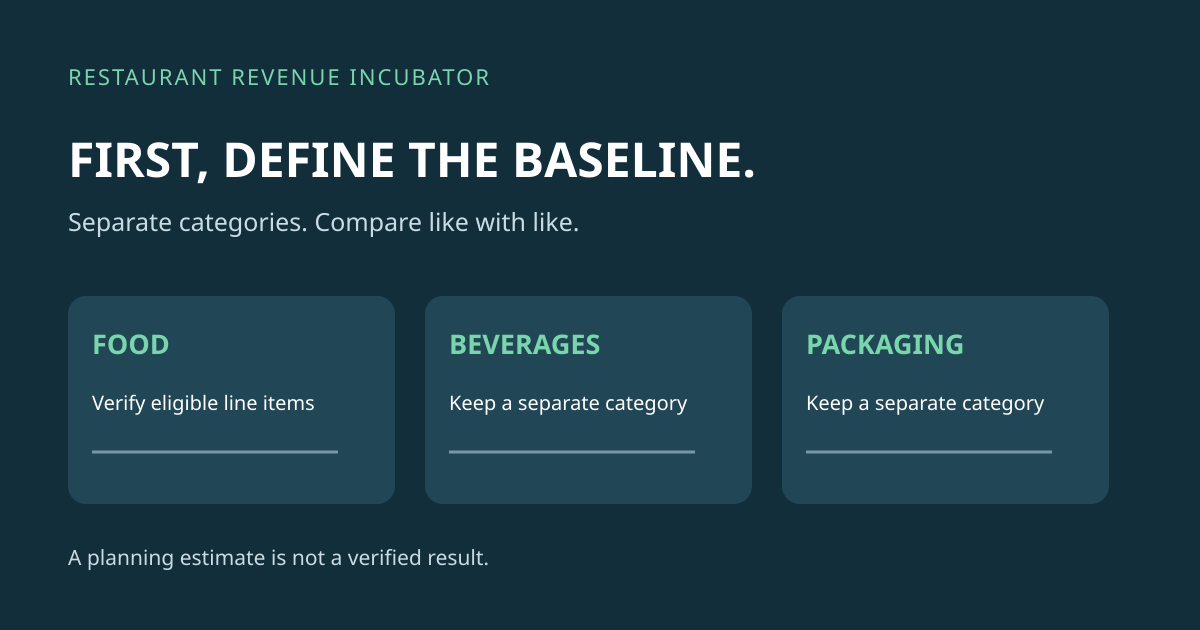
A lower number on a price sheet is an invitation to look closer, not a finished savings calculation. Before changing a supplier or accepting a purchasing proposal, establish what the restaurant is buying now—and what a fair comparison would include.
The first job is not to make the opportunity look bigger. It is to make the starting point clear enough that another person can check it.
Keep food separate from everything that arrived with it
A delivery can contain food, beverages, packaging and other supplies. That does not make the whole invoice eligible food spending.
Identify the actual food line items in a defined period. Keep beverages, packaging and nonfood supplies in their own categories. If a combined invoice cannot be separated reliably, flag it for review rather than applying a food-only assumption to the total.
Record how credits, returns, taxes and delivery charges are handled. Use the same treatment on both sides of a comparison, and keep unresolved items visible.
Compare the product, not just the case price
Two cases are not necessarily the same purchase. Check the item specification, pack size, quantity and unit of measure. A lower case price can still be a poor comparison if the case contains less product or a different specification.
For items where preparation affects usable quantity, document the restaurant’s measured yield rather than inventing one. Keep substitutions visible. A proposed product that changes portioning, prep work or the guest experience needs an operating review, not just a price comparison.
The invoice tells you what was purchased. The kitchen helps explain what can actually be used.
Choose a period that explains the operation
Write down the period, location and source records. Note unusual events, missing invoices, menu changes or closures that might make the period misleading.
Do not compare one unusually quiet week with a busy holiday week and call the difference a purchasing result. Where the activity or mix changed, identify that change before attributing the result to a supplier decision.
A useful baseline includes its limitations. ‘These invoices are complete except for one unresolved credit’ is more useful than a confident total whose gaps nobody recorded.
Keep a planning estimate separate from a verified result
For a clearly labeled planning illustration, RRI uses an assumed five-percentage-point reduction in food cost as a share of sales—for example, from 30% to 25%. At $5 million in annual sales, that scenario represents $250,000 in annual gross modeled savings. This is a planning assumption, not a verified achievable result or a guarantee. It is different from a 5% reduction in food spending.
If the eligible food base is unknown, do not calculate the illustration. Do not add payment-processing benefits, incremental sales, incentives, tax benefits or funding proceeds to the food-savings line. Those are separate questions with separate evidence.
After a change, compare actual supported results using the same definitions. Record implementation costs and material operating changes separately so the review does not confuse an estimate with a confirmed outcome.
Bring evidence to the first conversation
Start with a short checklist: the period and locations, itemized purchase records, category rules, pack and specification details, known credits, and unresolved questions. Keep sensitive records in the appropriate controlled channel; a public contact form is not the place for banking, payment-card or employee information.
Restaurant Revenue Incubator offers a free restaurant diagnostic. Use that first conversation to identify which part of the baseline needs work and what can be compared fairly.
The useful question is not ‘How large can we make the savings number?’ It is ‘What would we need to see before we believed it?’
Planning your next project? See how much upfront cash your restaurant could get, or book 15 minutes with David.