Revenue Growth · Uncategorized
Eco-Friendly Restaurant Profit Blueprint: Turn Food Waste Into $100K+ Revenue (No Upfront Investment)
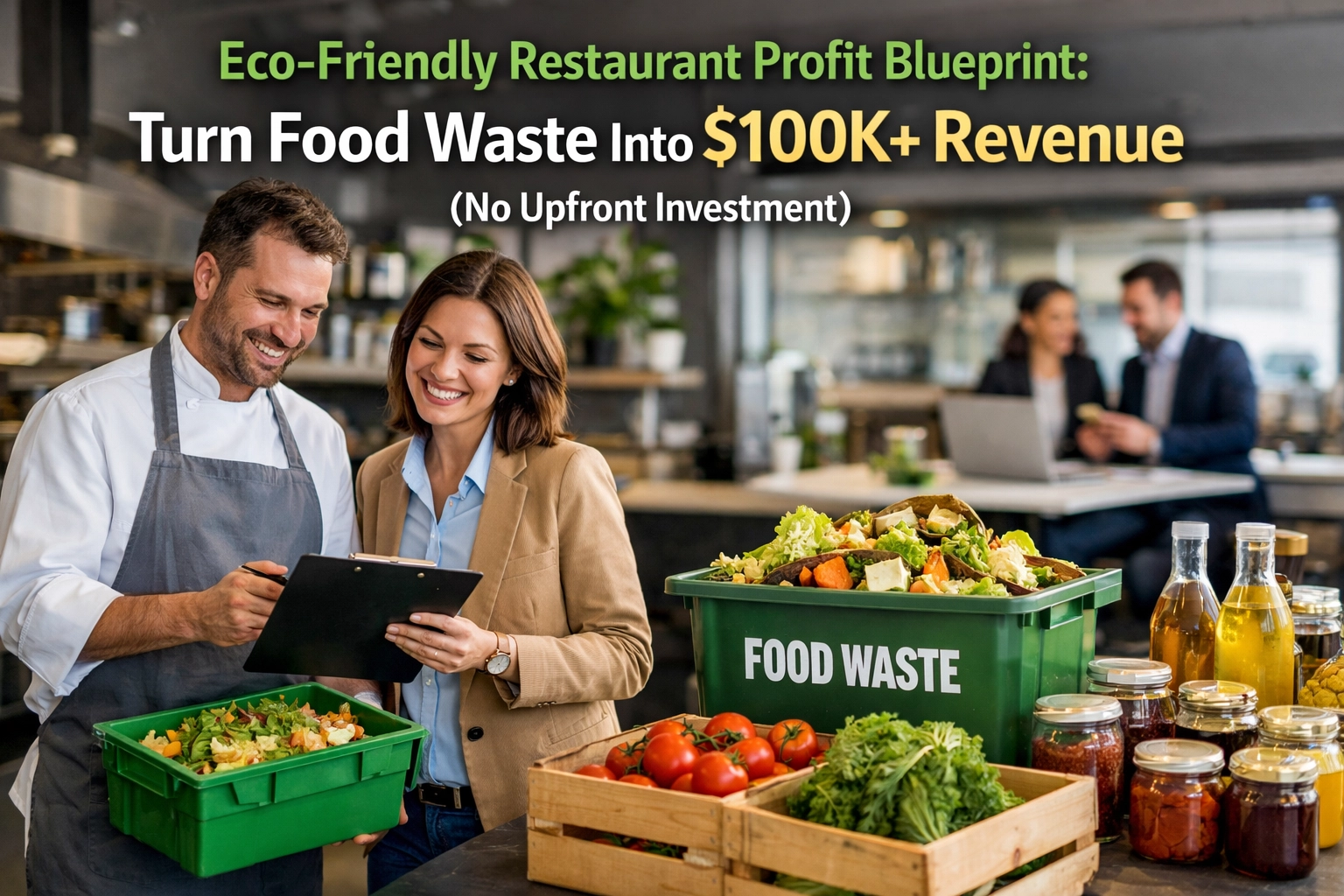
Let's talk about money. Specifically, the money you're literally throwing in the dumpster every single day.
According to the latest industry data, the average restaurant tosses between 4-10% of its food inventory straight into the trash. For a mid-sized operation doing $2M annually, that's somewhere between $80,000 and $200,000 in pure waste. And here's the kicker: every dollar you invest in food waste reduction returns approximately $14 in savings. That's a 1,300% ROI, better than crypto, real estate, or that cousin's "guaranteed" MLM scheme.
The triple bottom line, People, Planet, Profit, isn't some feel-good corporate buzzword anymore. It's a legitimate competitive advantage. And in 2026, with 91% of consumers actively preferring restaurants that reduce food waste, "going green" isn't just good ethics. It's a revenue strategy.
The $620 Million Opportunity Nobody's Talking About
A study of 114 restaurants across 12 countries revealed something wild: the average restaurant made $7 in returns for every $1 spent on waste reduction initiatives. Not $1.50. Not $3. Seven dollars.

When you scale that across the entire U.S. restaurant industry, prevention solutions like waste tracking and analytics offer nearly $620 million in combined annual profit potential. And we're not talking about installing a $500K composting system or hiring a sustainability consultant at $200/hour. The highest-ROI strategies require almost zero upfront capital.
Here's the breakdown of what actually moves the needle:
Waste Tracking & Analytics: Implementing simple daily waste logs can cut food costs by 2-6%. For a restaurant spending $50K/month on inventory, that's $1,000-$3,000 in monthly savings, $12K to $36K annually. All you need is a clipboard, a scale, and 10 minutes per shift.
FIFO Inventory Rotation: First In, First Out. It costs nothing except a 15-minute training session with your team. Yet it's one of the most powerful spoilage prevention tools available. Label everything with receiving dates, organize shelves by expiration, and watch your "shrinkage" line item drop by 20-30%.
Structured Staff Meals: Instead of ordering pizza for the team or letting them grab whatever, create a formal staff meal program using surplus inventory and near-expiration ingredients. You redirect waste, boost morale, and turn a P&L line item (employee meals) into a waste-reduction tool.
The "Too Good To Go" Revenue Stream
Let's get into the immediate revenue plays. Apps like Too Good To Go, goMkt, and Food Rescue US let you sell end-of-day surplus at steep discounts (typically 60-70% off). You're not making full margin, but you're recovering at least some ingredient costs instead of literally paying to have food hauled to a landfill.
Here's the math on a single location:
- Average daily surplus: $150 in cost (retail value ~$450)
- Recovery rate through discount apps: 30% of cost = $45/day
- Monthly recovery: $45 × 30 days = $1,350
- Annual recovery: $16,200
Multiply that across multiple locations, and you're quickly approaching that $100K+ revenue benchmark, not from new sales, but from recovering what you were already throwing away.

The bonus? These apps handle the marketing, customer acquisition, and payment processing. You literally just list your surplus, and people show up to buy it. Zero marketing budget required.
The Triple Bottom Line in Action
Here's where the "People, Planet, Profit" framework stops being abstract and starts printing money:
People: Your team feels good about working for a brand that doesn't waste. Turnover drops. In 2026, when 70% of restaurant operators report that labor quality is their #1 concern, anything that improves retention is gold. Plus, structured staff meals using surplus inventory improve morale without hitting your labor cost percentage.
Planet: Reducing landfill waste lowers your disposal costs (yes, you literally pay per ton to throw food away). Composting partnerships and organic waste collection programs often cost less than traditional waste hauling. One operator we know in Portland cut their monthly waste bill from $2,400 to $900 by switching to a composting service. That's $18K/year in savings.
Profit: Beyond the direct savings and recovery revenue, you're building brand equity with the 91% of diners who actively prefer sustainable restaurants. That's not a small niche: that's the mainstream market in 2026.
The "Upcycled Ingredient" Menu Trend
One in five restaurants now feature upcycled ingredients on their menus. This isn't about serving "scraps": it's about culinary creativity that happens to boost margins.

Real examples from the field:
- Vegetable trim and peels become "house-made vegetable stock" or "root-to-stem salads"
- Day-old bread transforms into croutons, breadcrumbs, or French toast specials
- Citrus peels become candied garnishes, syrups, or infused cocktail ingredients
- Meat trim becomes staff meals, chili, or "daily butcher's special" dishes
The revenue impact isn't just cost savings: it's menu engineering. A "root-to-stem" salad priced at $14 has a food cost of maybe $2.50 (since you're using trim that would have been waste). That's an 82% gross margin. Compare that to a traditional salad at 70% margin, and you're adding real dollars to the bottom line.
How to Hit $100K+ Without Spending a Dime
Here's the playbook for a mid-sized operation (let's say 3-5 locations doing $6-8M combined):
Phase 1: Waste Tracking (Month 1)
- Implement daily waste logs at each location
- Identify top 10 waste items by cost
- Expected savings: 2-3% of food cost = $10K-$15K annually
Phase 2: Recovery Revenue (Months 2-3)
- List surplus on Too Good To Go or similar apps
- Partner with local food banks for prepared surplus
- Expected recovery: $15K-$20K annually
Phase 3: Menu Engineering (Months 4-6)
- Add 3-5 upcycled ingredient dishes per location
- Train kitchen staff on trim utilization
- Expected margin improvement: $20K-$30K annually
Phase 4: Operational Efficiency (Months 7-12)
- FIFO implementation and compliance
- Structured staff meal program
- Composting partnership
- Expected savings: $30K-$40K annually
Total Year 1 Impact: $75K-$105K
And that's with zero upfront capital investment. Just operational discipline, menu creativity, and partnerships with existing platforms.

The Regulatory Tailwind
California's SB 1383 (organic waste diversion mandate) is just the beginning. More states are adopting similar regulations, and the penalties for non-compliance are steep. Restaurants that get ahead of this aren't just saving money: they're avoiding future fines.
But here's the opportunity: compliance and profit aren't mutually exclusive. The same strategies that keep you compliant (waste tracking, composting, donation programs) are the ones generating the biggest ROI.
The "No Upfront Cost" Model
This is where Restaurant Revenue Incubator comes in. We don't charge you $50K to "audit your operations" or install expensive tech. Our model is simple: we help you implement these waste reduction strategies, and we get paid from the savings and recovered revenue.
If you don't save money, we don't make money. It's that straightforward.
We handle the waste tracking setup, negotiate composting partnerships, connect you with recovery apps, and train your team on menu engineering. You focus on running your restaurants. We focus on turning your waste into profit.

The 2026 Advantage
Right now, with food costs up 40% since 2019 and 42% of restaurant operators reporting they're unprofitable, waste reduction isn't optional: it's survival.
But here's the thing: most operators still see "sustainability" as an expense. They think it's about buying expensive compostable packaging or hiring a Chief Sustainability Officer. That's the old playbook.
The new playbook is this: sustainability is a profit center. It's margin expansion disguised as environmentalism. It's revenue generation disguised as compliance.
And the best part? You can start today. No capital expenditure. No loan applications. No board approvals.
Just a decision to stop throwing money in the dumpster.
Ready to turn your waste into revenue? Let's talk. We'll run a free waste audit on your operations and show you exactly where the $100K+ opportunity is hiding. No cost. No commitment. Just data.
Because in 2026, the restaurants that win aren't the ones spending the most on marketing or renovations. They're the ones squeezing every dollar of margin out of operations: including the dollars they used to throw away.