Restaurant Technology · Uncategorized
How to Integrate Sustainable Kitchen Operations With Your Tech Stack to Slash Costs
Let’s be honest: in the restaurant world, "going green" used to sound like an expensive hobby for owners who had too much time and not enough bills. It felt like something you did to get a window sticker, not something you did to save your P&L.
But times have changed. In 2026, sustainability isn't just about hugging trees; it’s about hugging your margins. At Restaurant Revenue Incubator, we’ve seen hundreds of concepts struggle with the same two-headed monster: rising ingredient costs and skyrocketing utility bills.
The secret weapon to slaying that monster? The Triple Bottom Line (People, Planet, Profit). By integrating eco-friendly practices directly into your tech stack, you aren't just saving the world: you’re padding your bank account. And the best part? We specialize in helping you find these efficiencies with a risk-free, no-upfront-cost approach. We only win when you win.
In this deep dive, we’ll show you how to turn your kitchen into a lean, green, profit-generating machine.
1. The Triple Bottom Line: Why "Eco" Means "Economy"
Before we jump into the wires and software, let’s talk about the why. The Triple Bottom Line is a framework that evaluates a business on three levels:
- People: Social responsibility and employee retention (which, as we know, is the industry’s biggest headache).
- Planet: Reducing environmental impact (waste, energy, water).
- Profit: The financial return on investment.
When you integrate sustainability into your tech stack, these three things align perfectly. Less food waste (Planet) means lower COGS (Profit). A smarter, tech-enabled kitchen (Tech) means less burnout for your staff (People).
The Staggering Stats
- AI-driven food waste tools can cut kitchen waste by 50%.
- This translates to a 2–8% reduction in total food costs.
- Energy-efficient IoT controls can slash electricity use by 20–30%.
If you aren't integrating these into your operations, you’re essentially leaving a stack of cash on the grill and walking away.
2. Waste Not, Want Not: AI and the "Planet" Metric
Food waste is a silent profit killer. Every time a chef over-preps or a line cook tosses a half-used head of lettuce, your margin shrinks.
The traditional "waste log" (a soggy clipboard in the back of the house) is where data goes to die. To truly slash costs, you need to integrate AI waste tracking into your daily workflow.
How it Works:
Systems like Winnow or LeanPath use a camera and a smart scale to identify exactly what is being thrown away. This data isn't just for a report; it integrates with your Restaurant Management System (RMS).
When your waste data talks to your inventory data, magic happens. You start seeing Actual vs. Theoretical (AvT) food cost variance in real-time. If your system knows you should have used 50 lbs of steak based on sales, but you actually went through 60 lbs, the AI waste tracker will tell you if those 10 lbs went into a guest’s stomach or the trash can.

[Prompt for image 2 (generated above): A high-tech, clean digital dashboard displayed on a tablet in a professional kitchen. The screen shows vibrant charts and graphs indicating a 50% reduction in food waste and significant cost savings. The lighting is natural and modern.]
3. The "Profit" of Smart Sensors: IoT and Energy Efficiency
Your walk-in cooler is probably the most expensive "roommate" you’ve ever had. It drinks electricity and, if it fails at 2:00 AM on a Sunday, it can destroy thousands of dollars in inventory.
Integrating Internet of Things (IoT) sensors into your tech stack is the ultimate "set it and forget it" cost-saving move.
The Integration Play:
- Smart Refrigeration: Sensors track temperature and humidity 24/7. If a compressor starts cycling inefficiently or a door is left open, your manager gets an instant SMS. No more "discovery" of spoiled milk on Monday morning.
- Demand-Controlled Ventilation: Most kitchen hoods run at 100% capacity all day. Integrated sensors can detect heat and smoke, adjusting fan speeds to match actual cooking levels. This can cut energy costs by 30%.
- Smart Thermostats: Link these to your POS. When the "End of Shift" button is hit, the HVAC automatically adjusts to an eco-mode.
At Restaurant Revenue Incubator, we perform a full tech stack review for free. We often find that restaurants are paying for high-tech tools but only using 10% of their capabilities. We help you bridge that gap without you ever reaching for your wallet upfront.
4. Scaling the "People" Factor: Tech That Retains Talent
Scaling a restaurant concept is impossible if you have a revolving door of staff. High turnover is the ultimate sustainability failure.
Sustainable operations prioritize the "People" part of the Triple Bottom Line by using tech to make work easier, not harder.
- Digital Inventory: Nobody likes staying until midnight to count cans of beans. Integrated inventory systems that use mobile scanning (like MarketMan or Toast) turn a two-hour chore into a 15-minute task.
- Automated Oil Management: Cleaning fryers is the worst job in the kitchen. Systems that automate oil filtration and replacement not only extend the life of your oil (saving money) but also improve safety and morale.
When your kitchen is high-tech and eco-conscious, you attract a different breed of talent: people who care about the brand they work for.

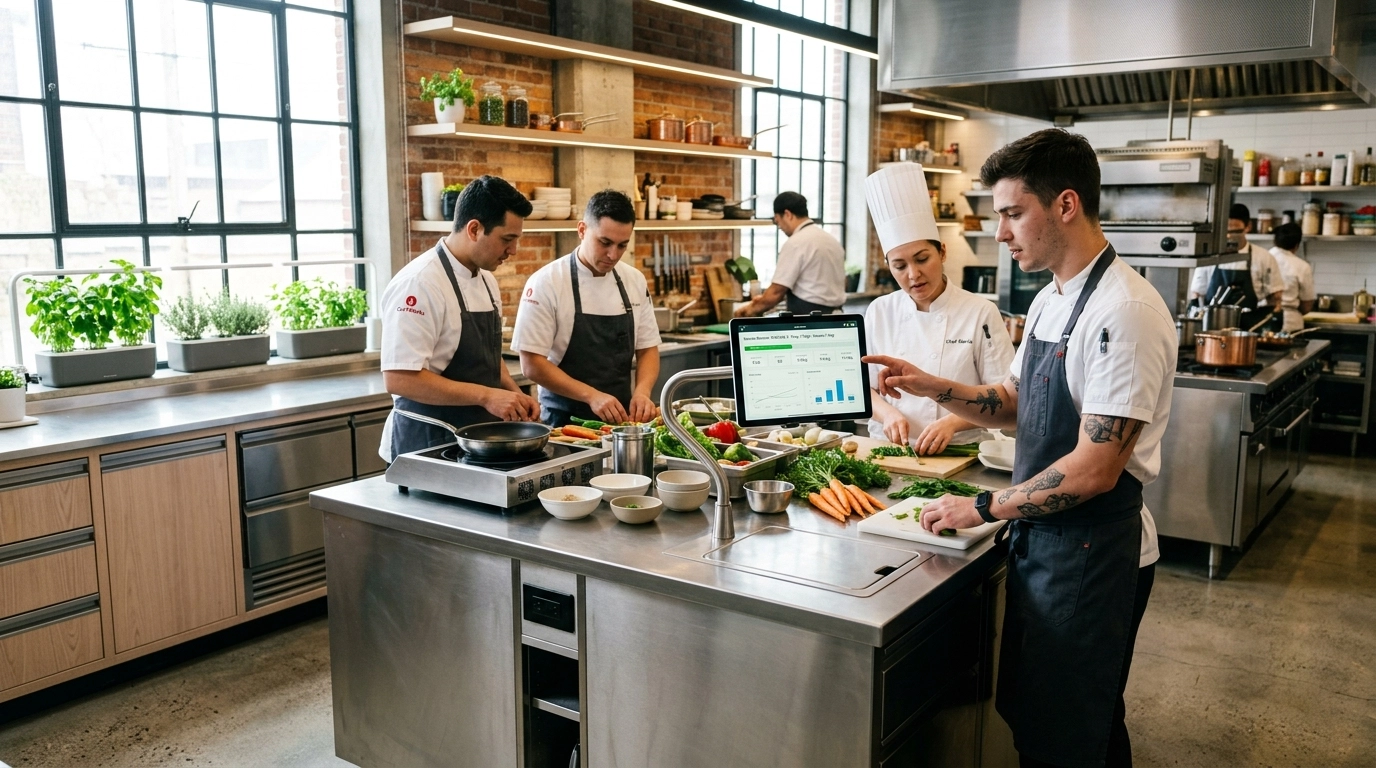
[Prompt for image 3 (generated above): A diverse team of professional kitchen staff collaborating and smiling in a modern, sustainable kitchen. They are using sleek handheld devices for inventory. The atmosphere is positive, professional, and features natural sunlight and clean lines.]
5. From Single Unit to Scale: The Roadmap to Profit
Sustainable operations provide the data foundation necessary for growth. If you want to scale your brand, you need a repeatable, efficient model that works across 10 locations as well as it does in one.
The Sustainable Scaling Checklist:
- Centralize Your Data: Ensure your POS, RMS, and waste tracking all live in the same cloud.
- Benchmark Everything: Use your first location to set the "gold standard" for energy use per cover and waste per cover.
- Optimize Sourcing: Use your tech-driven inventory data to negotiate better rates with suppliers who offer sustainable packaging and local sourcing.
- Leverage Surplus Marketplaces: Use apps like Too Good To Go to sell surplus food at the end of the day. It’s "trash" turned into "cash."
The "No Upfront Cost" Turnaround
If this sounds like a lot of work, that’s because it is. But you don't have to do it alone. At Restaurant Revenue Incubator, we’ve spent 50+ years in the trenches of both public and private restaurant groups.
We don't charge you a massive retainer to tell you what's wrong. Instead, we dive into your P&Ls and tech stacks for free, find the hidden leaks, and implement these sustainable integrations ourselves. We only ask for a share of the results we create.
Whether you need alternative funding through food & beverage credits to kickstart your green upgrades or full-scale franchise development, we are your partners in growth.
Conclusion: The Future is Green (and Profitable)
The "old way" of running a restaurant: ignore the waste, ignore the electricity bill, and just try to sell more burgers: is dead. To survive in today's market, you need a kitchen that is as smart as it is sustainable.
By integrating your tech stack with sustainable operations, you aren't just doing "the right thing." You’re building a business that is resilient, scalable, and: most importantly: profitable.
Ready to see how much you could be saving?
Let us review your tech stack and P&L at no cost. We can turn your business around in under 2 weeks. Let’s build something that lasts.

[Prompt for image 4 (generated above): A sophisticated, professional image representing restaurant growth. A modern architectural rendering of a multi-unit restaurant concept under clear blue skies, with integrated greenery and solar panels. The vibe is aspirational, professional, and high-growth.]