Restaurant Technology · Uncategorized
How to Integrate AI Automation With Sustainable Kitchen Operations to Slash Overhead
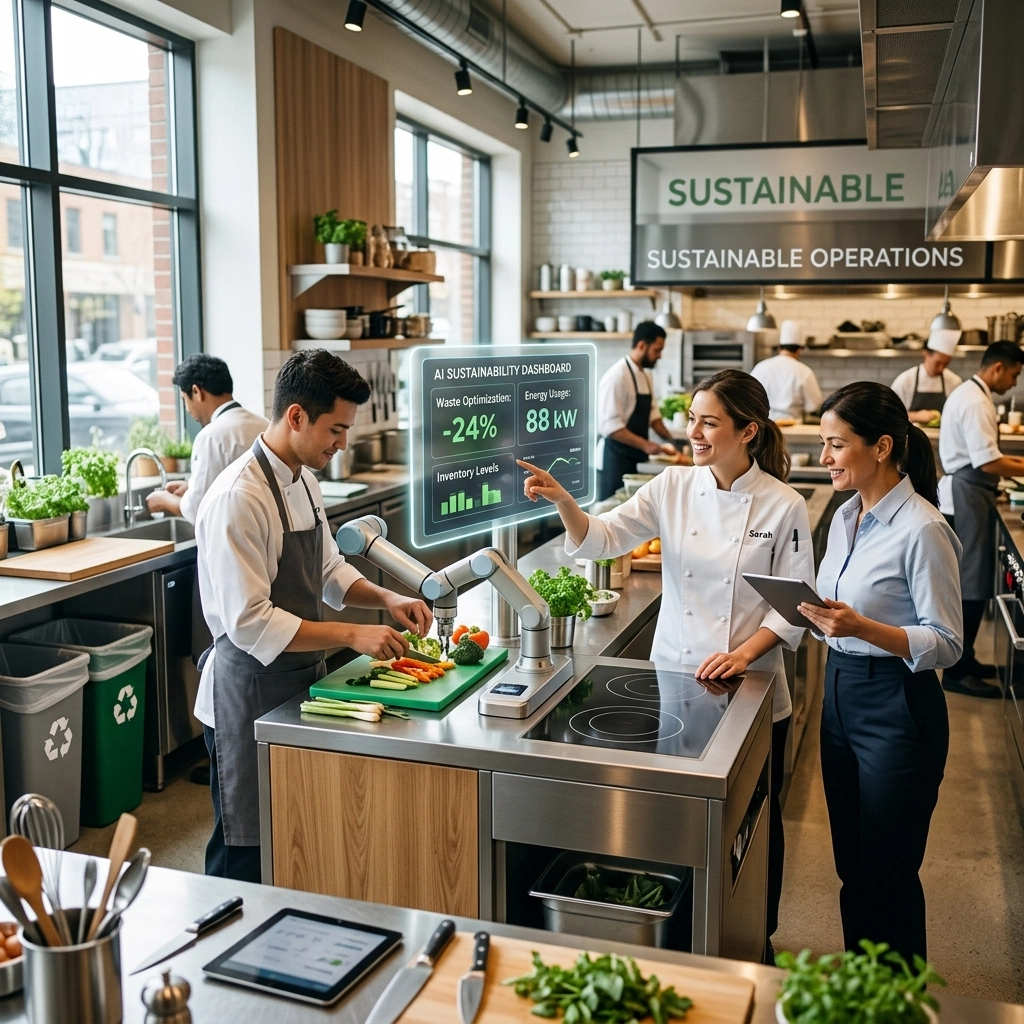
Let’s be honest: the traditional restaurant model is a bit of a dumpster fire. And I mean that literally: between the staggering amount of food waste tossed out every night and the energy bill that looks like a mortgage payment for a small island, the "old school" way of doing things is burning through your margins.
In the past, "sustainability" was often viewed as a luxury: something you did if you had an extra five figures lying around and a desire to put a sprout logo on your menu. But in 2026, sustainability isn't just about hugging trees; it’s about hugging your bottom line. At Restaurant Revenue Incubator, we view this through the lens of the Triple Bottom Line: People, Planet, and Profit.
If you want to survive the current economic climate, you have to stop thinking of AI and sustainability as separate departments. When you integrate AI automation with green operations, you aren't just saving the world; you’re slashing overhead so deeply it’ll make your accountant weep with joy.
The Ghost in the Machine: Why AI is the Ultimate Sous Chef
The biggest drain on any restaurant is uncertainty. How many chickens should we prep for Tuesday? Will the walk-in die over the weekend? Is the grill cook leaving the burners on full blast during the 3 PM lull?
AI doesn't get tired, it doesn't have "gut feelings" that are usually wrong, and it certainly doesn't forget to check the expiration dates on the heavy cream. Integrating AI into your kitchen operations allows you to move from reactive management to predictive mastery.
1. Predictive Inventory and the End of the "Trash Can Dividend"
Food waste accounts for a massive portion of lost revenue. Most kitchens over-order by 10-15% "just in case." That "just in case" is basically a direct donation to the local landfill.
AI-powered systems now analyze years of historical sales data, local weather patterns, and even neighborhood events to tell you exactly what you’re going to sell. If there’s a rainstorm coming on a Wednesday, the AI knows you’ll sell 40% more soup and 20% less salad. By automating your procurement through these insights, you reduce spoilage (Planet) and keep that cash in your bank account (Profit).

2. IoT: Giving Your Appliances a Brain
Your walk-in freezer is a silent killer. If a seal is loose or a compressor is struggling, it’s sucking up electricity like a vacuum. IoT (Internet of Things) sensors integrated with an AI dashboard provide real-time monitoring.
Instead of finding $4,000 worth of spoiled steak on Monday morning because the freezer quit on Saturday night, the AI alerts your phone the second the temperature deviates by two degrees. Commercial kitchens account for nearly 30% of a building's energy usage. By using AI to optimize when equipment is powered up and down, you can cut energy consumption by 20-30% almost overnight.
Automation: Empowering People, Not Replacing Them
One of the biggest misconceptions about automation is that it’s a "job killer." In the Triple Bottom Line framework, the People element is vital.
Labor is the highest overhead cost in the industry. But here’s the secret: your staff doesn’t want to spend four hours a day peeling potatoes or doing repetitive, mind-numbing prep work. They want to cook, create, and serve.
Robotic Task Automation (RTA)
We’re seeing a massive shift toward robotic systems for high-repetition tasks. Whether it’s an automated fry station that ensures perfect consistency every time or a robotic salad maker, these tools handle the "drudgery."
When you automate the boring stuff:
- Consistency goes up: The AI doesn't "forget" the salt.
- Labor costs stabilize: You can scale production without a 1:1 increase in hiring.
- Employee retention improves: Your chefs are actually doing chef work, leading to higher job satisfaction.
If you’re looking to scale your concept, check out our Growth & Scaling category for more on how tech-heavy models are dominating the market.

The Sustainable Synergy: Green is the New Gold
When you combine AI's data-crunching power with sustainable hardware, the overhead reduction becomes exponential. Let’s look at a few "Green Tech" wins:
- Smart HVAC Systems: These use AI to sense kitchen heat and adjust ventilation. No more running the hood fans at 100% capacity when there’s only one pan on the stove.
- Automated Waste Tracking: Systems like Winnow use AI-assisted scales to categorize what’s being thrown away. If the AI notices you're tossing $200 worth of lemon wedges every week, it suggests a change in prep or menu design.
- Water Optimization: AI-controlled dishwashing cycles and low-flow sensors can reduce water bills by thousands annually.
The Triple Bottom Line in Action
To understand why this matters, you have to look at the math. A restaurant operating on a 5% margin that saves $1,000 in food waste has the same impact on the bottom line as increasing sales by $20,000.
Which is easier: convincing 1,000 new people to buy a burger, or using an AI tool to stop throwing burgers in the trash?
| Feature | Impact on People | Impact on Planet | Impact on Profit |
|---|---|---|---|
| Predictive Ordering | Less stress over-prepping | Reduced landfill waste | Lower COGS (Cost of Goods Sold) |
| IoT Energy Monitoring | Safer food storage | Lower carbon footprint | 20-30% lower utility bills |
| Kitchen Robotics | Reduced physical burnout | Less energy/water per unit | Lower labor-to-revenue ratio |
How to Get Started (Without Emptying Your Savings)
I know what you’re thinking. "Robert, this sounds great, but I don't have $100,000 to turn my kitchen into a NASA laboratory."
This is where the Restaurant Revenue Incubator model changes the game. Most operators are stuck in a "pay-to-play" cycle where they can’t afford the tech that would save them money. It’s the classic "poor man’s tax": you spend more on waste and labor because you can’t afford the automation to stop it.
We operate on a No Upfront Cost turnaround basis. We identify the tech stack and the sustainable initiatives that will move the needle for your specific location, we implement them, and we share in the increased revenue. We’re so confident in the synergy of AI and sustainability that we put our skin in the game.
Whether you need a new tech stack or a complete operational overhaul, you can browse our product sitemap to see the types of solutions we integrate, or even grab some of our merch to look the part while you're revolutionizing your kitchen.

The Future is Automated (and Efficient)
The era of the "gut-feeling" restaurateur is coming to an end. The winners of the next decade will be those who embrace the "Intelligent Kitchen." By integrating AI automation with sustainable practices, you aren't just checking a box for a PR firm. You are building a resilient, high-margin machine that treats its people well, respects the planet, and generates massive profit.
Stop letting your overhead bleed you dry. The tech is here, the data is clear, and with our help, the cost is no longer a barrier.
If you're ready to see how your specific kitchen can benefit from an AI-driven, sustainable makeover, take a look at our author sitemap to connect with our specialists who have done this for hundreds of brands.

The bottom line: AI doesn't just make your kitchen smarter: it makes it leaner. Sustainability doesn't just make you look good: it makes you wealthy. Put them together, and you’ve got a restaurant that’s built to last.
Ready to stop the burn? Let’s get to work.