Restaurant Technology · Uncategorized
Do You Really Need That Fancy Tech Stack? Here’s the Truth About Sustainable Kitchen Operations
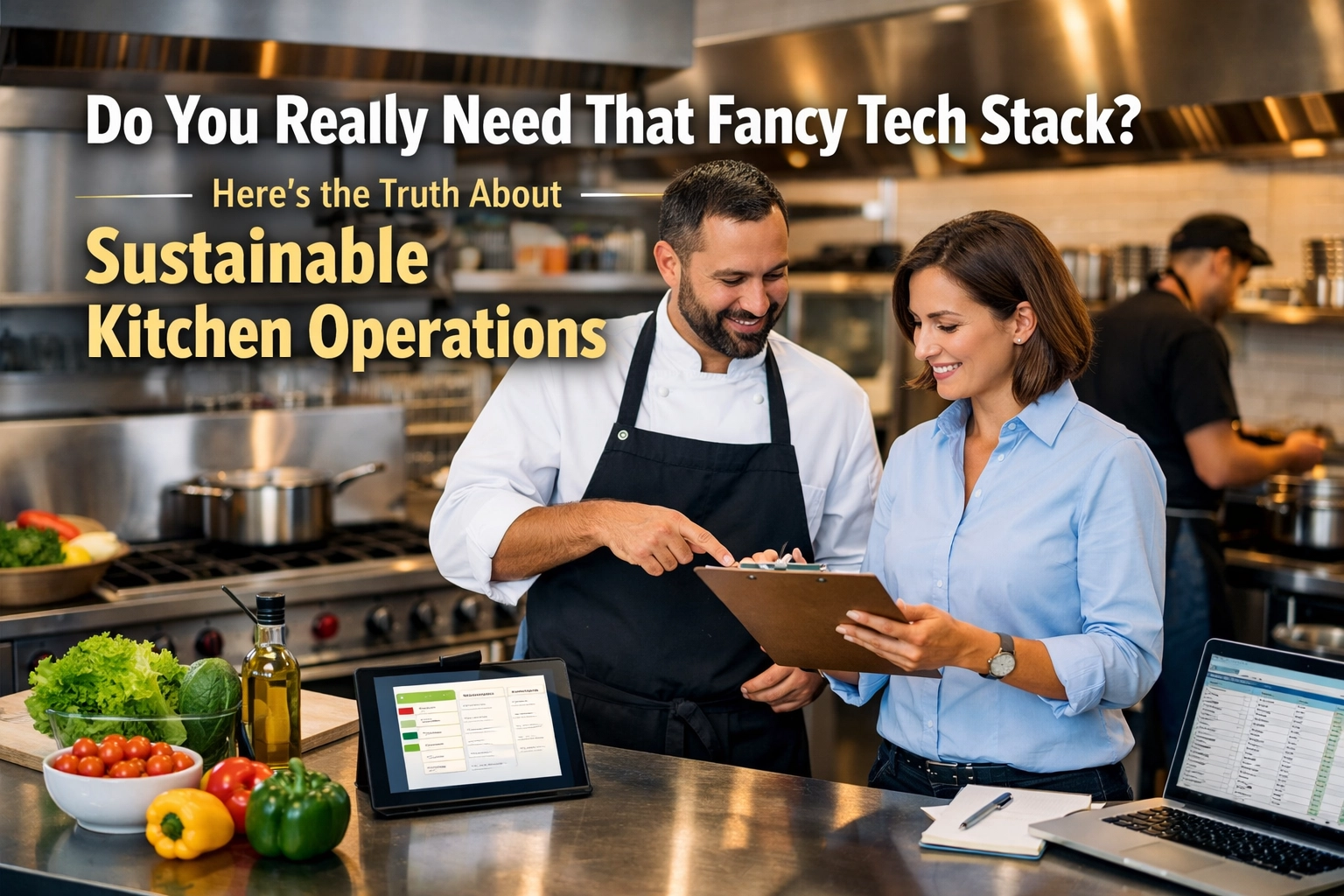
Let’s be honest: walking through a modern restaurant trade show feels a bit like stepping into a sci-fi convention. You’ve got robots flipping burgers, AI programs that claim to predict exactly how many avocados you’ll need next Tuesday, and "smart" refrigerators that probably have a higher IQ than some of my college roommates.
If you’re a restaurant owner or operator, it’s easy to feel the "Tech FOMO." You see a competitor install a $20,000 kitchen display system (KDS) integrated with a biometric waste-tracking bin, and suddenly your clipboard and Sharpie feel like relics from the Stone Age.
But here is the million-dollar question: Do you actually need all that gear to run a sustainable, profitable kitchen? Or is that "fancy tech stack" just a shiny distraction from the fundamental leaks in your P&L?
At Restaurant Revenue Incubator, we spend our days helping operators scale and turn around struggling concepts. We love data, and we love efficiency. But we also love the truth. And the truth is that technology is a tool, not a savior. If your operations are a mess, a $50,000 tech stack will just help you record your failure in high definition.
Today, we’re doing a deep dive into sustainable kitchen operations through the lens of the Triple Bottom Line: People, Planet, and Profit. Let’s look at where tech actually moves the needle and where you’re just buying a very expensive iPad holder.
The Triple Bottom Line: Why "Green" is the New "Black"
Before we talk about the gadgets, we have to talk about the "Why." In the old days, sustainability was seen as a luxury, something you did for PR or because you really liked composting.
In 2026, sustainability is a survival strategy. We look at it through the Triple Bottom Line framework:
- Profit (The Financials): Reducing waste and energy consumption directly lowers your COGS and utility bills.
- Planet (The Environment): Lowering your carbon footprint and diverting waste from landfills.
- People (The Culture): Creating an efficient environment where staff aren't overworked by chaotic, wasteful processes.
When these three align, you don't just have a "green" restaurant; you have a high-performance machine. The right tech stack should serve all three. If it only serves one (like a gadget that looks cool for the "Planet" but kills your "Profit"), it’s a bad investment.

The "Shiny Object" Trap: When Tech Goes Wrong
I’ve seen it a hundred times. A CEO buys a top-of-the-line inventory management system with all the bells and whistles. Six months later, the staff is still using a whiteboard because the software is too "clunky" and "takes too long."
The tech stack becomes a burden rather than a benefit. This is the "Tech Debt" of the restaurant world. If your tech doesn't simplify the "People" part of the Triple Bottom Line, the "Profit" part will never follow.
Sustainable operations start with systems, not software. Software just automates the system. If you don't have a culture of portion control and recipe adherence, a fancy AI inventory tool will just give you very accurate data about how much money you’re losing.
Where Technology Actually Wins: Data-Driven Sustainability
Now, I'm not a Luddite. Technology, when applied correctly, is the ultimate multiplier for sustainability. Research shows that while manual processes can get you halfway there, data-driven tech is what gets you to the finish line.
1. The War on Food Waste
Food waste is the silent killer of restaurant margins. A mid-sized restaurant using digital food waste tracking often discovers that up to 30% of their waste comes from over-preparing specific menu items. Without tech, you’re just guessing. With it, you’re adjusting.
One study found that AI-powered waste systems can cut food waste by a staggering 60% or more. Imagine taking 60% of the food you currently throw in the trash and keeping it in your walk-in, or better yet, never buying it in the first place. That is the "Profit" and "Planet" alignment we’re looking for.
2. The IoT Energy Revolution
Ever walk into your kitchen at 10:00 AM and realize every burner, fryer, and heat lamp is already blasting, even though the first customer doesn't arrive until noon? That’s money literally vanishing into the air.
IoT (Internet of Things) sensors can monitor energy consumption in real-time. These systems can alert a manager when a walk-in cooler door is left ajar or when energy usage spikes unexpectedly. It’s not "fancy" for the sake of being fancy; it’s a digital watchdog for your utility bill.

Scaling Sustainable Concepts
If you’re looking to grow, which is a core theme here at Restaurant Revenue Incubator, you cannot scale a "gut feeling."
You can run one kitchen on intuition. You can maybe run two. But by the time you hit five units, you need a unified tech stack that provides visibility across all locations. This is where the "Growth & Scaling" theme intersects with "Restaurant Tech." Sustainable scaling requires a "single source of truth."
If Location A has a 4% food waste margin and Location B has an 8% margin, you need to know why. Is it a leadership issue? A training issue? Or is the equipment at Location B failing? Technology provides the transparency needed to lead effectively from the CEO's chair.
Leadership: It Starts at the Top
We often feature successful operators in our spotlights, and the common thread is never "I bought the most expensive software." Instead, it's "I used data to empower my people."
Sustainable leadership means giving your team the tools to succeed. If you give a chef a digital inventory tool that saves them four hours of manual counting every week, you’ve just improved their quality of life (People) and the accuracy of your ordering (Profit). That’s a leadership win.
However, if you force a complicated system on a team that is already underwater, you’re not being a leader; you’re being a hurdle.

The "No Upfront Cost" Reality Check
The biggest barrier to sustainable tech is, unsurprisingly, the price tag. Most operators look at the cost of high-end sensors, AI waste tracking, and integrated KDS and say, "Maybe next year when we’re more profitable."
The irony is that you’re not profitable because you don't have these efficiencies.
This is why our "No Upfront Cost" turnaround services are so popular. We believe that if a system is truly "sustainable," it should pay for itself through the savings it generates. We help restaurants optimize their tech stacks and kitchen operations by focusing on the low-hanging fruit first, the stuff that saves enough money to fund the next level of innovation.
Whether you're looking for a new t-shirt for your crew or a complete overhaul of your revenue model, the goal is always the same: lean, mean, and green.
Practical Steps to a Sustainable Stack
If you’re feeling overwhelmed by the "Fancy Tech Stack" pressure, here is our recommended roadmap:
- Audit the Manual: Before buying software, ensure your manual processes (prep lists, waste logs) are actually being used.
- Focus on Waste First: Invest in a digital waste tracking system. It usually has the fastest ROI of any restaurant tech.
- Monitor Energy: Simple IoT sensors for your refrigeration can save thousands in spoiled product and energy bills.
- Integrate, Don't Isolate: Ensure your POS, inventory, and labor platforms talk to each other. "Data silos" are where profits go to die.
- Train for Adoption: If your staff doesn't know how to use it, it's not a tool; it's a paperweight.

Conclusion: Do You Really Need It?
So, do you really need that fancy tech stack?
If "fancy" means gadgets that look cool but don't provide actionable data, then no. You’re better off spending that money on better ingredients or staff bonuses.
But if "fancy" means a systematized, data-driven approach that measures impact, identifies hidden inefficiencies, and allows you to scale your sustainability efforts across multiple locations, then yes. You can’t afford not to have it.
In the end, the most sustainable thing you can do for your restaurant is to ensure it stays in business. By balancing the Triple Bottom Line and using technology as a scalpel rather than a sledgehammer, you can build a kitchen that is good for the planet, good for your people, and incredibly good for your bank account.
Are you ready to stop guessing and start growing? Check out our shop for some gear, or better yet, reach out to us to see how we can help you scale your concept with zero upfront costs.
Let's get cooking. Professionally, of course. (But maybe with a little humor: because if we didn't laugh at the chaos of the restaurant industry, we'd all be in a different business.)