Restaurant Technology · Uncategorized
The Saturday Brief: ICE Enforcement Impact, Starbucks' Pivot, and Jollibee's Big U.S. Bet
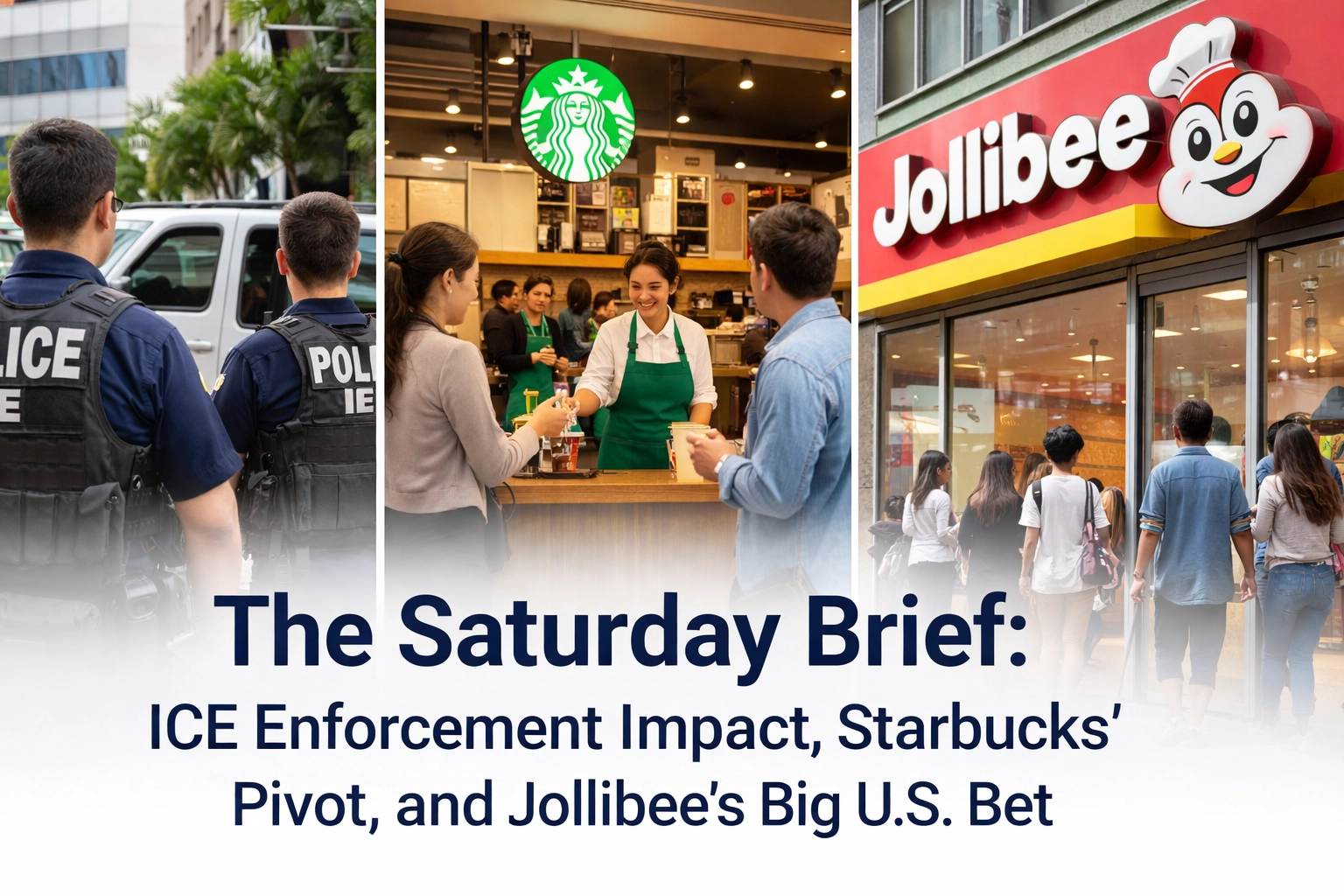
Meta Description: Your January 24, 2026 restaurant industry news roundup covering ICE enforcement's impact on labor, Starbucks' strategy pivot under Brian Niccol, Jollibee's U.S. IPO plans, and Noma's $1,500 LA residency.
Tags: restaurant industry news 2026, restaurant labor challenges, Starbucks strategy pivot, Jollibee US IPO, restaurant operational efficiency, immigration enforcement restaurants, QSR trends
Happy Saturday, operators. Grab your coffee, we've got a lot to unpack this morning.
This week's news hits different. We're seeing the collision of policy, economics, and bold corporate bets all at once. From immigration enforcement reshaping labor dynamics to a Filipino chicken giant making moves on Wall Street, the restaurant industry news for 2026 is already proving that this year will be anything but boring.
Let's get into it.
The ICE Effect: Labor Fear Is Hitting the Bottom Line
The elephant in the room right now isn't inflation, it's immigration enforcement.
Reports are surfacing from multiple markets about restaurants in immigrant-heavy neighborhoods experiencing temporary closures, reduced hours, and severe staffing shortages. The cause? Intensified ICE (Immigration and Customs Enforcement) operations that are creating a climate of fear among workers and their families.
According to recent coverage from Restaurant Business Online, the Trump administration has allocated a staggering $170 billion over four years for immigration enforcement, with at least $75 billion designated specifically for interior enforcement, arresting, detaining, and deporting immigrants already living in the U.S. That's a dramatic jump from the roughly $30 billion allocated in 2024.
The numbers tell the story: estimates suggest approximately 310,000 to 315,000 removals in 2025, with an additional 210,000 to 405,000 immigrants leaving voluntarily due to enforcement pressure.

What This Means for Your Operation
For restaurant owners, this isn't a political debate, it's a restaurant labor challenge that directly impacts your ability to open your doors. Here's what we're seeing on the ground:
- Increased no-shows and sudden departures from otherwise reliable staff
- Reduced applicant pools in markets with heavy enforcement activity
- Operational disruptions requiring last-minute schedule changes and overtime costs
- Community-level sales dips as foot traffic decreases in affected neighborhoods
The triple bottom line lens applies here: People (your team's security and well-being), Planet (food waste from unpredictable service levels), and Profit (overtime costs, lost sales, recruitment expenses).
The move: If you're in a vulnerable market, now is the time to cross-train aggressively, document your processes, and build redundancy into your staffing model. We cover operational resilience strategies in our cost reduction services, because efficiency isn't just about cutting costs, it's about surviving disruption.
Starbucks Earnings: Can Brian Niccol Reverse the Slide?
All eyes are on Seattle today as Starbucks reports earnings under new CEO Brian Niccol.
If you've been following the Starbucks saga, you know 2025 was rough. Traffic declines, mobile order bottlenecks, and a brand identity crisis had investors nervous. Niccol, the former Chipotle CEO credited with that brand's turnaround, was brought in to stop the bleeding.
His "early wins" strategy has focused on three pillars:
- Simplifying the menu to reduce complexity and speed up service
- Reinvesting in the "third place" experience, making stores feel like destinations again, not just pickup windows
- Tech stack optimization to fix the mobile order chaos

According to QSR Magazine, the Starbucks strategy pivot is already showing early signs of life. Average ticket times are down in test markets, and customer satisfaction scores have ticked up for the first time in 18 months.
But here's the real question: can a brand this big actually pivot fast enough?
The Lesson for Independent Operators
You might think, "I'm not Starbucks, this doesn't apply to me." Wrong.
The core lesson here is about restaurant operational efficiency. Niccol isn't reinventing the wheel. He's doing three things that any operator can do:
- Cutting menu bloat (fewer SKUs = faster ticket times = happier customers = lower food costs)
- Investing in the in-store experience (people want a reason to visit, not just order)
- Fixing broken tech (if your POS, KDS, and online ordering don't talk to each other, you're bleeding money)
This is the playbook. Starbucks is just running it at scale.
If you haven't audited your own tech stack lately, we offer a free P&L and tech stack review, just DM us the word "SCALE" and we'll set it up.
Jollibee's U.S. IPO: The Chicken Wars Just Got Interesting
Here's a story that flew under the radar but deserves your attention.
Jollibee Foods Corporation, the Filipino fast-food giant known for its fried chicken and spaghetti (yes, spaghetti), is spinning off its non-Philippine operations into a new U.S. publicly traded company.
This is a massive move.
Jollibee already operates over 1,500 locations outside the Philippines, including brands like Smashburger, The Coffee Bean & Tea Leaf, and their flagship Jollibee stores. The Jollibee US IPO is designed to capture American investor capital and accelerate their chicken segment expansion.

Why does this matter? Because the chicken wars are about to get a new, well-funded competitor. And unlike Popeyes or Chick-fil-A, Jollibee brings a differentiated flavor profile and a cult-like following among Filipino-American communities (and increasingly, the mainstream).
The Franchise Development Angle
If you're in the franchise game: or thinking about scaling your own concept: this is a case study in smart capital structure. By spinning off international operations, Jollibee can:
- Access U.S. capital markets directly
- Attract investors who want pure-play exposure to American QSR growth
- Move faster on real estate and development deals
For more on scaling concepts and franchise development strategies, check out our revenue optimization services.
The $1,500 Dinner: Noma Comes to LA
On the opposite end of the spectrum, let's talk about Noma.
The Copenhagen-based restaurant: often called the best in the world: is bringing a temporary residency to Los Angeles. The price tag? $1,500 per person.
Before you roll your eyes, hear me out.
This isn't just about rich people eating fancy food. It's a signal about the experience economy and the resilience of high-income consumer spending. Even in uncertain economic times, there's a segment of the market willing to pay a premium for something truly unique.
The takeaway for operators at every price point: experience matters. Whether it's a $15 burger or a $1,500 tasting menu, the brands winning right now are the ones creating moments worth remembering (and posting about).
The Bottom Line: Saturday's Takeaways
Here's your cheat sheet for the week:
| Topic | Key Insight | Your Action Item |
|---|---|---|
| ICE Enforcement | Labor disruptions are real and spreading | Cross-train staff, build scheduling redundancy |
| Starbucks Pivot | Simplicity and speed win | Audit your menu and tech stack |
| Jollibee IPO | Smart capital structure accelerates growth | Study how brands scale efficiently |
| Noma LA | Experience-driven dining is thriving | Double down on what makes you memorable |
Ready to Optimize Your Operation?
If this week's news has you thinking about your own P&L, labor model, or tech stack, we're here to help.
DM us the word "SCALE" for a free P&L and tech stack review. No strings. Just clarity on where you're leaving money on the table: and how to fix it.
Until next time, stay sharp out there.
( Penny @ Restaurant Revenue Incubator)